 By admin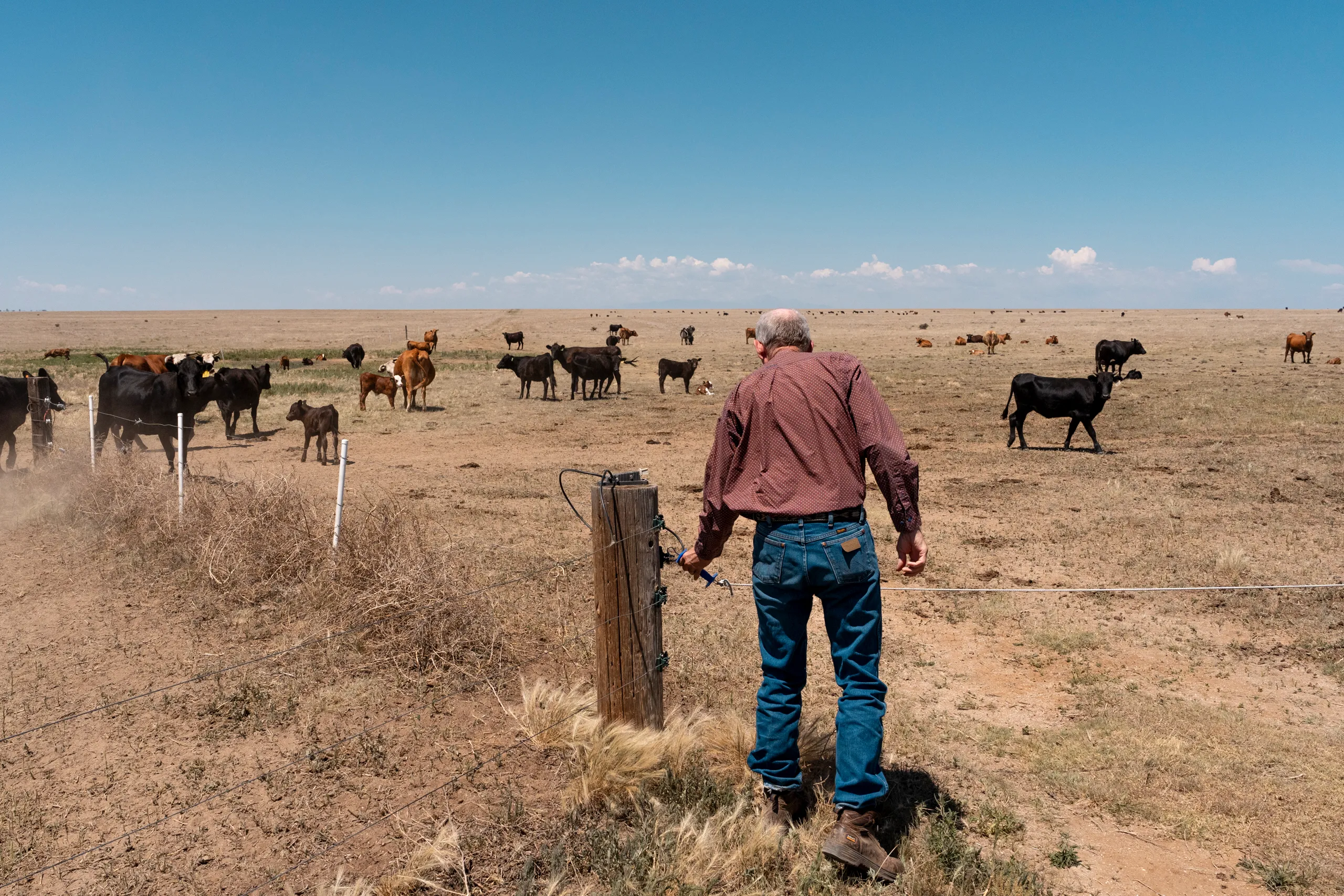
MESA COUNTY — Last year, the VanWinkle family fought flames to keep their cattle business alive. This year, they’re fighting drought — and they worry the drought will be worse.
Read more Pity the lonely brook trout: How to stop an invasion with this one genetic trick
The Turner Gulch fire sparked after dry lightning swept through Mesa County in mid-July, threatening lives, homes and infrastructure. As the flames raced across the dry landscape during hot and windy days, the fire spread into the vast high country where ranchers, like the VanWinkles, grazed hundreds of cows on federal land.
The family’s No. 1 goal was not to lose cattle, Janie VanWinkle remembered. They woke up at dawn to be on-site in case they needed to move the herd. When cows became separated, they would run in to look for the animals between slurry drops. At one point, only a half-mile from the fire, VanWinkle got slurry on her arm.
“Then we would run in and look for cows,” she said. “Then we would run out and wait for the next round. It was intense.”
The fire burned for 47 days, but the family’s work continued for another two and a half months as they managed the herd on unfamiliar grazing land and brought them out of the high country in the fall, VanWinkle said.
“It was really hard,” she recalled, driving her truck across arid land on a 90-degree day in mid-May. “We expect the next 180 days to be twice that because of drought.”
Ranchers in Mesa County are in an extreme drought following a record-low snowpack that melted a month earlier than usual after a heat wave in March. The University of Nebraska U.S. Drought Monitor says the drought is even worse in Pitkin County. Out in Lincoln County on the Eastern Plains, the 50,000-acre Brett Gray Ranch is sitting pretty through moderate drought and “abnormal dryness” affecting the Eastern Plains since April.
The Continental Divide splits Colorado in half, but lack of water unites communities on both sides. Ranchers across the state have the same needs but different resources. How are they faring as spring tilts into summer? And what can they learn from one another?
“The landscape and the cattle are everything,” VanWinkle said. “That’s what we have to take care of no matter what.”
Where’s dinner?
In the ranching business, the needs don’t let up. And neither is this drought.
Parts of Colorado have been in drought for the majority of the past 25 years, according to the U.S. Drought Monitor. Last year, the Western Slope endured months of summer drought while the Eastern Slope escaped mostly unscathed. After the winter that wasn’t, every county in the state has experienced some level of drought since early April. About 97% of Colorado was in drought as of June 16.
Jeff Tranel, who offers financial resources to farmers and ranchers through Colorado State University Extension, is seeing and hearing more tension in his communications with ranchers: “They’re gritting their teeth a little bit. They’re not as comfortable making decisions that need to be made.”
Colorado agriculture generates approximately $47 billion annually in economic activity, employs 195,000 people, covers 30 million acres of farmland and encompasses 36,000 operations, according to Colorado Department of Agriculture figures.
Cattle and calves are also the top commodities, contributing $4.46 billion to the state economy. And Colorado ranchers contribute a massive amount to the U.S. beef supply: In 2024, the state said they produce 1.7 billion pounds of beef annually, .
But their numbers are falling, as USDA data released in February shows. The 1.8 million U.S. farms the agency counted in 2025 were down from 1.88 million in 2024 and 1.90 million in 2022.
Farmers and ranchers are also aging out of the business: Their average age in Colorado is 58, with many older than 65, according to Colorado State University.
And their children are waving goodbye to the family business, due to everything from skyrocketing land costs and water rights to new labor laws to the seemingly inescapable drought.
There isn’t much water running into ditches on the Western Slope right now, which means ranchers are using every tool in the toolkit to find food for their herds.
Many move their cattle to the highlands to graze on land they lease from the federal government, including Tim Nieslanik, who runs around 300 head on his ranch near Carbondale. He irrigates with water from the free-flowing Crystal River, part of the Colorado River Basin.
The prolonged megadrought affecting Colorado’s Western Slope set in during 2000, escalated in 2002 and worsened in 2020-21, sparking unprecedented water shortages.
Like VanWinkle, Nieslanik is trying to figure it out.
“I don’t know what’s gonna happen”
In early May, while sipping a Coors Light on the deck of his friend Richard McIntyre’s place after a long day of work, Nieslanik said he had never seen the Crystal River as low as it was — because there was only 17% to 23% of the normal snowpack in the Crystal River drainage that feeds it.
“It’s not pretty, and I don’t know what the hell is gonna happen, because this really hasn’t happened before,” the third-generation rancher added. “Last year at the end of the year, the river was nothing, but (at) this time of year, it was running. And now it’s barely running.”
Water is also scarce on the federal grazing allotment Nieslanik leases with two other ranchers.
“The springs and creeks that have normally been there are not,” he said.
During spring, he rotates grazing his cattle on four different pastures. Nieslanik gets his water a century-old ditch that diverts flow from the Crystal for agricultural and municipal use.
In fact, he helps manage the East Mesa Ditch, which provides water to 10 shareholders, including several ranches and a few that were sold and are now small subdivisions. The ranchers irrigate around 740 acres of hay, alfalfa and pastureland south of Carbondale, says McIntyre, and water rights on the Crystal extend back to the late 19th century, with the earliest documented agricultural diversions dating to the 1880s.
If the water gets too low, it could become impossible for some of the shareholders to operate, McIntyre noted.
“Then you’ll really have to decide how much sharing can be done,” he explained. “As the amount of water gets less and less, senior rights are key, and those with the most senior rights are going to be the last man standing, presumably. But does water in the Crystal River last until June? Does it last til July? Does it go to August? These are critical times for ranchers to be able to put up enough hay to feed their cows.”
Nieslanik said he would keep his cattle on pastureland until early June, then move them onto his federal allotment. But he was already worried in May, because there are no roads where they graze, so he won’t be able to haul water.
“And if we can’t haul water they’re gonna run out,” he said.
If that happens, he’ll have to bring his cattle back down to pasture early.
“But we don’t really have enough hay to give them all summer, either,” he said.
Higher costs for things like fertilizers (essential for pasture management), interest rates on operating loans, fuel and labor are further straining ranchers’ wallets, said Tranel, CSU’s agricultural business expert.
Ranchers might have to take out a loan to buy feed. They might decide to sell some (or all) of their cattle — that’s a decision many are facing this year. And as their budgets become more strained, the economic ripple effects spread further.
Read more What’s Working: Why hamburgers cost more today
The farm family has less money for groceries, shopping in town, giving to charities and buying new vehicles or equipment. That means less for the local economy, Tranel said.
On June 10, Nieslanik wasn’t considering offloading any of his herds, because flows in the Crystal River were still holding. But there’s a lot of summer to go.
“It feels like a really bad wreck”
Weeks after Nieslanik pondered his drought-affected future, Janie VanWinkle stood under the blazing sun on the side of a hard-packed gravel road in Mesa County, watching drought impact her business in real time.
The VanWinkles have operated their Western Slope ranch near Grand Junction for decades, through both good years and the Colorado River Basin’s 25-year megadrought. Earlier this season, her family had made the risky decision to keep as much of their herd as possible.
This year, they might end up scrambling for enough food and water to get their cattle to the weight required in their sales contracts. But they sold half the herd in 2002 because of drought, and it took them seven or eight years to rebuild. She didn’t want to repeat the experience.
That morning, her son, Dean VanWinkle, woke early, hoping to move the cattle 12 miles to their federal forest allotments, where forage grows naturally. But they’d have less time on their leased land, in part because the Bureau of Land Management needed to reduce impacts from hungry herds on the parched landscape.
That meant Dean was on his horse working cattle on a 90-degree day in May instead of a cooler day in April. It was complicated enough on a normal day, let alone in above-average heat. Grand Junction’s average temperature in May is closer to 76 degrees. But it would be worth it, Janie figured.
As soon as she saw the first calf ambling toward the road, Janie knew their plan had gone awry.
The cows ran off and left their calves after getting over the first hill. Calves started walking back to their start pasture, and their mothers slowly came back to find them. The ranchers spent hours on horseback under the blazing sun trying to reunite cows and their calves spread across the landscape.
The heat was stressful for their horses, their dogs — and the cows. And without a watering hole between their starting pasture and the leased land 12 miles away, the ranchers couldn’t stop wrangling the herd until they finished the journey.
“It feels like a really bad wreck right now,” Janie said, shielding her eyes from the sun as she scanned the scattered herd. “You got to get them to water, though. That’s the key.”
The ranchers worked until long past dark. The journey saved the family about $150 per cow-calf pair, she said. Still, by mid-June, they could no longer keep the herd intact. The family decided to sell 35 cows to reduce their feed costs.
It was a painful decision, Janie said. The cows they sold would have given birth to calves, which would eventually have been going to their direct-to-consumer beef business about two and a half years from now. By selling those cows, they’ll have less local beef available in 2028 and 2029.
“We waited as long as we possibly could to make that decision,” she said.
A better scenario on the Eastern Plains
As Janie was deciding to cut her herd, Louis Martin focused on moving his cattle from pasture to pasture to limit their impact on the landscape.
Martin’s company, Round River Resource Management, manages the 50,000-acre Brett Gray Ranch out on the Eastern Plains in Lincoln County. It’s publicly held by the State Land Board with around half of it in a conservation easement held by The Nature Conservancy. And it operates with the goal of being a productive ranch while supporting the prairie ecosystem surrounding it and showing the public how the two can exist in tandem.
Martin has been ranch manager there for 22 years, and he currently runs around 2,000 cattle, which he rotates every few days between a dozen or so paddocks.
And he’s fortunate, because unlike VanWinkle and Nieslanik, Martin doesn’t have to rely on snowpack for water. Steels Fork Creek starts on and runs through the property, fed by the Ogallala Aquifer.
The ranch has senior water rights on the creek, so as long as the aquifer is high enough, the cattle will be OK. But the aquifer may not always be a guaranteed source: Martin has seen flows in Steels Fork Creek drop significantly since he started managing the ranch in 2008, a trend he attributes to “a lot of pumping” on farms and ranches “up north of us,” he said.
Unrelenting drought on the Eastern Plains hasn’t helped either: The overall trend here is one of rapid drought intensification and expansion, which forces farmers to increase groundwater pumping to sustain their yields. That, in turn, drains the aquifer much faster than it naturally recharges through the slow percolation of precipitation through the soil.
But thanks to recent rain in Lincoln County, Martin has another advantage over ranchers on the Western Slope.
“We normally see around 13.7 inches of rain annually, but last year an extra four inches fell,” he said. “And (as of June 10) our rolling 12 month average is 14.89 inches, so we’re still above average for the last 12 months of what you’d expect is normal precipitation.”
That rain fills a couple of small reservoirs dug by previous owners. Martin controls the gates that release to fill water tanks for his cattle.
LEFT: Mud found at the headwaters of the Steels Fork Creek hints at water on Martin’s ranch Monday, June 15, 2026, in Lincoln County. RIGHT: Cattle quench their thirst on the Brett Gray Ranch Monday, June 15, 2026, in Lincoln County. (Cheney Orr, Special to The Colorado Sun)
Drought or not, he’s always mindful about conserving the precipitation he gets with rotational grazing, wherein he lets his cows munch on a paddock no more than five days at a time before rotating them to the next, so those grasses can regrow.
“Ideally you don’t want an animal to bite the grass or the plant more than one time before it has a chance to recover,” he said, “so on most of our paddocks we’re grazing one to four days.”
Doing so leaves more grass on the land, which helps the ranch absorb rainfall. And as the cows rotate through the pastures, their hooves disturb the soil and churn the nitrogen, phosphorus, and potassium from their manure into the ground. That, in turn, feeds underground microorganisms and insects that create healthy land.
As Martin, VanWinkle and Nieslanik weigh their options this summer, they’re keeping an eye on forecasts to see if they can catch a break from the drought. If predictions of a moisture-laden super El Niño climate pattern come to fruition. Or if the summer monsoon season really is as active as meteorologists say.
Until then, they sit at kitchen tables poring over their accounting books, spend long days on horseback trying to find better pastures and keep their eyes trained on stream flows, like ranchers across Colorado.
Read more Lynn Bartels, reporter and “Grand Dame” of Colorado politics and, dies at 69