 By admin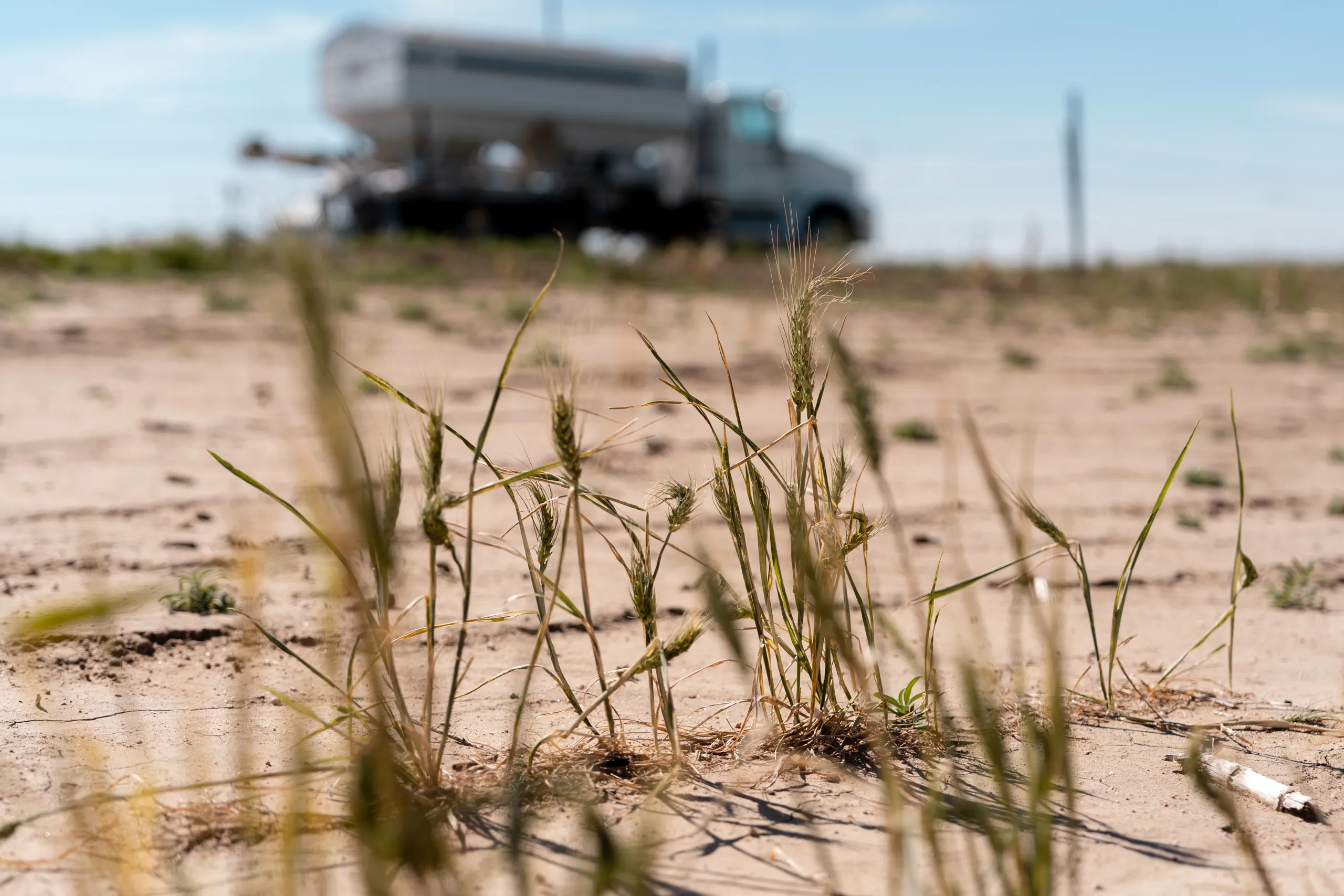
There’s something heartbreaking about the “amber waves of grain” that normally ripple across northeast Colorado this time of year; climate conditions have crippled the 2026 winter wheat crop.
Read more Sportsbooks have spent about $1.5M on Democratic, Republican statehouse primaries in Colorado
Instead of mile after mile of dense, waist-high stems and heads heavy with grain, this year’s crop rises barely more than ankle-high, is sparse and projected to yield a fraction of previous crops.
According to the U.S. Department of Agriculture’s National Agricultural Statistics Service, or NASS, Colorado is forecast to produce just 33.6 million bushels of winter wheat in 2026. This represents a 52% drop from the state’s 10-year average, resulting from severe drought and ill-timed periods of freezing temperatures across a wide swath of America’s wheat belt.
Most of the wheat grown in eastern Colorado is classified as No. 2 hard red winter wheat. It’s used mostly for baking bread and making noodles. It is planted in the fall and, ideally, sprouts before the first hard freeze, establishes its root system, and then goes dormant for the winter. Farmers then hope for adequate snow cover to prevent the green shoots from freezing and to provide early spring moisture. Adequate spring rainfall is needed for the wheat to reach its maximum growth and head size, followed by hot, dry weather to ripen the crop.
Almost none of those conditions have existed this year. Freezing temperatures, wind and a lack of snowfall damaged the crop over the winter. There was little or no snowmelt to water the crop during the spring warm-up. And precipitation has been dismal at best.
Brad Erker, executive director of the Colorado Wheat Administrative Council in Fort Collins, said that during the annual Wheat Field Days earlier this month he was told this year’s crop is the worst in recent memory.
“I had farmers who have been farming 50, sometimes 60 years, say it’s the worst they’ve ever seen,” he said. “NASS says it’s the worst since 1965, but I think even their numbers are a little optimistic.”
While drought and freeze are, according to Erker, the “short story,” the calamitous conditions stretch back even further. According to NOAA’s National Integrated Drought Information System, persistent dryness throughout 2025 left soil moisture in the zone where most roots are growing critically low across the High Plains.
A dry, warm winter caused the plants to flower three to four weeks early, making it more susceptible than usual to a late spring freeze. The crop also faced problems with viruses and wheat mites. It could have recovered with the right conditions, Erker said, but that didn’t happen.
“By early March we still had potential (for a profitable crop), but then no rain,” he said.
Combine crews have their own worries
The National Weather Service’s Akron reporting station, in the heart of Colorado’s wheat country, shows an accumulation of 3.71 inches of precipitation in the first six months of 2026, about half the normal accumulation of 6.3 inches. While the NWS is cautiously optimistic about late-spring and early-summer rainfall across the area, that’s too late to help wheat producers.
The result was stunted growth that produced plants almost too short to harvest.
“If you cut it too short, it doesn’t leave enough residue, and that residue (of bare stalks) is what protects the next wheat crop,” Erker said.
Harvest in Colorado normally begins in early July as custom cutters work their way north out of Texas and Oklahoma. Ryan Haffner, owner of High Plains Harvesting in Park, Kansas, said he expects his crews, now working in western Kansas, to be in northeast Colorado before the end of June. The harvesters are already finished in Texas and Oklahoma, where weather conditions were much the same as Colorado.
Read more Officials shut down Jefferson County park after first reported bear attack of 2026
When the harvesters do arrive, they’re going to face that challenge of short wheat stalks. Cutter heads will have to be much closer to the ground, which erases a margin of error for the combines.
“It’s not ideal, it can create extra wear and tear on the header and some additional grain loss from the difficulty of getting it in the header,” Haffner said. “But with these new machines, the technology helps us minimize that grain loss.”
Haffner said his crews are reporting a wide variety of crop yields this year, but mostly in the low numbers.
“We’ve seen some 60-bushel (per acre) wheat, but there’s a lot of it that’s 25 to 35 bushels,” he said.
Jordan Jensen, a partner in Northeast Agri-Services in Sterling, said producers are scrambling to find custom cutters for the early harvest. She said some crews are idle because so many fields in other states were abandoned, and they’re connecting with Colorado farmers eager to harvest.
Abandonment is another factor looming over the stubby wheat plants. In those cases, farmers throw in the towel and collect on their crop insurance policies. Jensen said it’s a tough decision for a farmer to make, but sometimes the hard facts dictate a Hobson’s choice.
“It can cost more to harvest 5-bushel (per acre) wheat than it’s worth, but if the adjuster says to harvest it, that’s what you do,” she said. “I had one (client) tell me they were going to have a second adjuster come out and look because it would cost too much to harvest.”
Some crop insurance policies allow a producer to receive the difference between actual yield and a pre-determined base yield, but even that can be an iffy compromise.
“There are so many variables that you can’t say for sure that’s going to happen,” Jensen said. “It depends on the policy you took out.”
Ordinarily, bad news in the field can be balanced out by good news in the marketplace, but Erker said there will be little effect on wheat prices beyond small local bumps.
“So much of the wheat price is determined on the global market,” he said, “and places like Argentina and Australia are having record years.”
Read more Are injuries from wind turbines common?