 By admin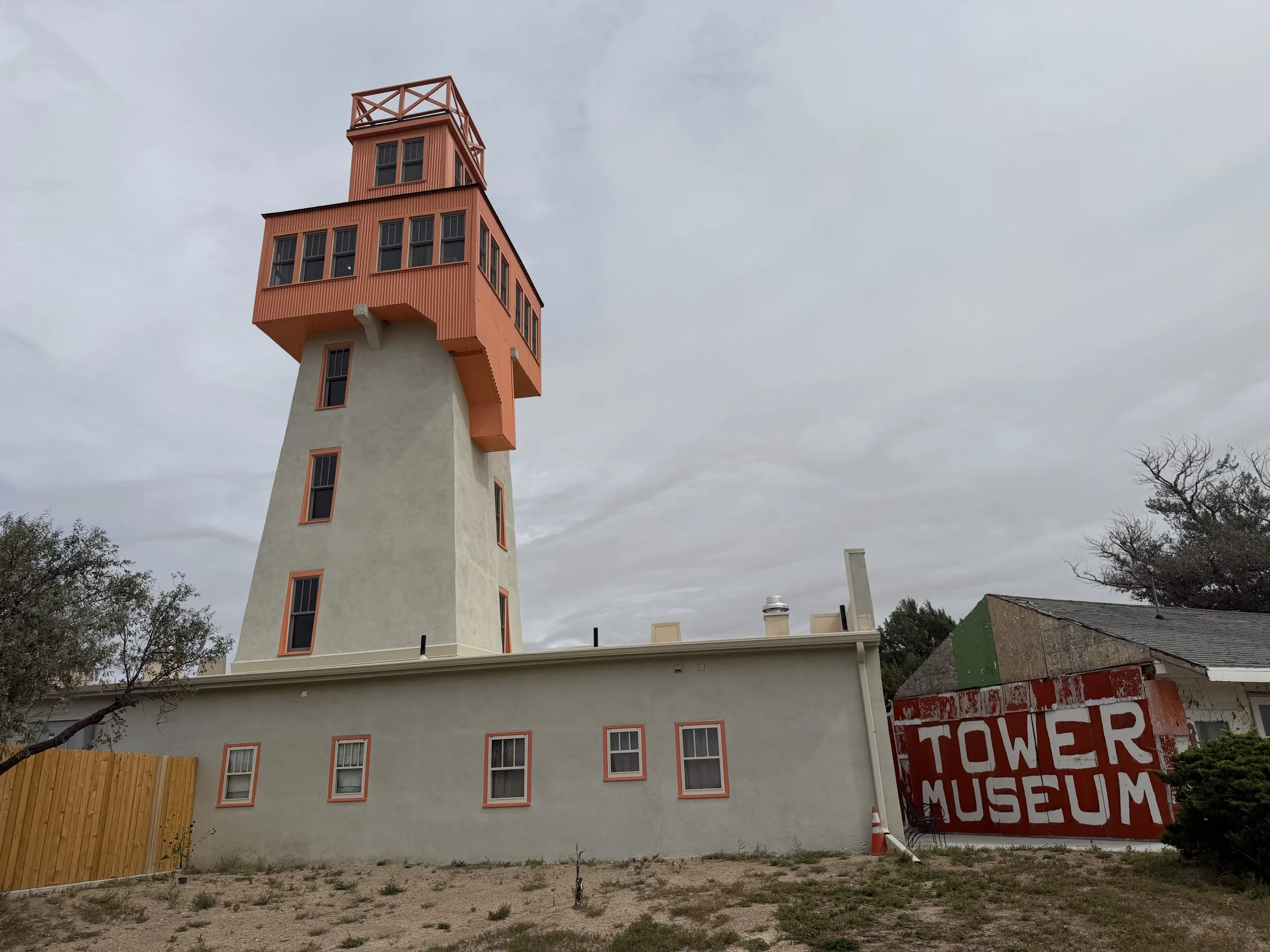
GENOA — The first thing you might notice driving east into Genoa is the sky. About 100 miles southeast of Denver, with the horizon cleared of jagged Front Range cityscapes, the view seems to be nothing but a smooth line where wheat and millet fields meet that massive expanse above.
Read more Colorado governor, an ex-beekeeper, takes executive action to save the bees
Once that has sunk in, you’ll likely spot a huge grain elevator at the east edge of town, and then maybe the scrawny water tower facing Interstate 70 with GENOA neatly painted in black.
Finally, if you happen to glance left at just the right time, you’ll spot the World’s Wonder View Tower, a Ripley’s Believe It or Not! roadside attraction and allegedly the highest point on the Eastern Plains.
From the top of the 100-year-old tower visitors can — allegedly — see six states: Colorado, New Mexico, Oklahoma, Kansas, Nebraska and Wyoming. Or, as the idiosyncratic phrasing painted on the side of the tower states: “By Ripley In Believe-It-Or-Not States To Be Seen.”
The tower sits about a half-mile west of the 153-person town, flaunting a fresh coat of paint in gray, maroon and tangerine, a nod to its 1960s color scheme. At the foot of the tower is a crumbling row of wood and stone buildings — a former café, theater and museum — patiently awaiting phases two and three of the three-part preservation plan.
Inside, the tower has been remade into a vertical museum, with four Denver artists taking over each of the four floors: Phil Bender on the first floor, Mark Friday on the second, Lonnie Hanzon on the third and Deborah Jang up top.
On Saturday the tower will celebrate its 100th anniversary and the beginning of its next era with an artist reception starting at noon.
More is more
For many years the view from the fourth floor was less of a draw to Colorado residents than the attraction’s longtime owner, Jerry Chubbuck, and his extensive collection of arrowheads, fossils, rocks, books, electric appliances and circus-like curiosities: the mummified cat, the “jackalope,” the two-headed calf. The cat and jackalope are still at the tower, on view now in the gift shop. The two-headed calf has been replaced by a stuffed representation.
“He had this habit where he’d go around and offer to give you your entry fee back if you could tell him what the object in his hand was,” recalled Troy McCue, executive director of Lincoln County Economic Development, who grew up in nearby Arriba. “He had so many things, he’d show you some old farming tool and almost no one would know what it was.”
McCue is on the board of the Friends of the Genoa Tower, the nonprofit formed in 2020 to preserve and renovate the site, which had fallen into disrepair after Chubbuck’s death in 2013.
LEFT: The Blue Room in the World’s Wonder View Tower in Genoa is filled with a found-object installation by Denver artist Phil Bender, part of the 100-year-old tower’s restoration. RIGHT: Troy McCue, executive director for Lincoln County Economic Development, points out details in the Yellow Room of the World’s Wonder View Tower. The tower had been shuttered for more than a dozen years. (Parker Yamasaki, The Colorado Sun)
Does McCue think you can see six states from the top of the tower?
“Well, you know, it was verified by Ripley’s. And the validity of our research is about as good as a letter from Ripley’s,” he said. “So it’s kind of,” he searched for the words, “kind of tongue-in-cheek.”
He turned to ascend the narrow, uneven staircase, so steep that paper signs on every landing urge visitors to sign a waiver and refrain from running.
“Before the restoration began I used to say ‘well sure you can see six states. You can see Colorado, Kansas, if you look down there you can see a state of disrepair, over there a state of despair …’” he said, trailing off as he ascended into the Blue Room.
The Blue Room occupies the first floor and is the first installation visitors encounter (three of the tower’s floors have been repainted in their original primary colors). The floor is decked out in hub caps, enamel cups and cookie boxes, arranged in tidy grids by artist Phil Bender.
When the tower and attached museum shut down in 2013 its contents were put up for auction, but not everything made it out the doors. There were still piles of paintings and birdcages and silverware, all sorts of bric-a-brac that the four Denver artists were invited to dig through for their installations.
A couple of stories up from Bender, Mark Friday remixed the museum’s raw materials into a collection of creatures, built from grates, spatulas and other odds and ends.
“There’s one made out of an old olive oil can, and one that has two heads because the place is famous for having a two-headed coyote or chicken or something,” Friday said. “There’s that curious sensibility to the tower, kind of bizarre and quirky. I fit right in.”
Read more Can Democrats win back voters in rural Colorado?
Jang’s work on the top floor mirrors Friday’s in her approach — chopping, painting and constructing new forms from remnants of the collection. Her pieces hang high up on the walls since the floor is covered in windows, offering a 360-degree view of the plains and, on a clear day, a glimpse of Pikes Peak. Oh, and the other five states. Allegedly.
Then there is Hanzon’s floor, The Red Floor, sandwiched between Friday’s funky faces and Jang’s serene and whimsical topper.
Hanzon picked through the museum’s abandoned objects but ultimately decided to do his own thing, with his extensive collection of … even more stuff.
“My gimmick is that I really dive deep,” Hanzon said. “I try to exhaust a subject to find its whole.”
His subject for the tower came straight from the tower floor itself: the color red. In his installation there’s a red library and red Christmas figures, cutouts of every brand that has sold a red-bottled perfume. There are tributes to Red Skelton, Redd Foxx and Red Buttons. Quotes and facts about the color red are attached to the walls.
“I always liked the color red. It is a picker-upper.” — Nancy Reagan
“Red is an attitude.” — Lady Gaga
“Red dye 3 was banned in the U.S. in 2025.” — unattributed
The oversaturation is intentional. Hanzon wants people to “leave their world and go into another for a few minutes,” he said.
Think of it like this: “Driving on the road is this very, very long sorbet, you’ve cleansed your palate. Then I’m sort of like the ice cream with sparklers,” Hanzon said. “Over the top.”
Go big and don’t go home
If the tower has an essence it’s probably in those three words: over the top.
From its beginnings in the 1920s, the founder Charles W. Gregory would stare down at cars passing on the old Highway 24 — the scar of which still crosses the property — and yell at drivers to come on up.
After passing hands a few times after Gregory’s death, the tower landed with Chubbuck in 1967, just a handful of years before the highway was replaced by I-70, and the exit for Genoa moved a mile east of the tower.
With the attraction slightly less convenient and well out of earshot for the curious passerby, Chubbuck’s own over-the-top collecting sensibilities kept the crowds coming.
That maximalism still underpins the quirky stop and photo op, but the latest iteration is a little more curated to the tastes and travel habits of contemporary Lincoln County: handpicked artists with dedicated installation spaces. Importantly for McCue, it also focuses more on the place’s own heritage.
“The exciting thing about the reboot of the Wonder View Tower, in my opinion, is that the new and improved site will feature art and eventually more history,” McCue said. “To me, that has more depth than just, oh, look at the freaky two-headed calf.”
Tourism will never be the county’s top draw, McCue admitted. Besides, tourist numbers are difficult to tease from people just traveling through. Nearby Limon is a six-way intersection of state highways and I-70 — one of the first signs travelers see at the exit reads “just ahead — 11 motels.” Despite the crossroads, accommodation and food services make up only about 8% of the county’s employment, dwarfed by healthcare, education, retail, construction and agriculture.
In Jang’s installation, a hint at the place’s history is leaning against a wall. McCue walked over to the stained, framed pages of a 1970s newspaper article celebrating the tower’s 50th anniversary. He read through the article and pointed to a photo taken “nearly 50 years ago” according to the caption, dating it to around the 1926 opening. A man in suspenders stands with his arms draped across the shoulders of the unnamed people next to him. C.W. Gregory, the tower architect, McCue said, pointing to the man.
“And this is Princess Raven Wing,” he said, moving his finger to a woman with a feather tied to the side of her head, who painted dozens of works during the place’s early days, some of which are still tucked away in the café. “I think she was a Sioux princess, but we don’t really know,” he said. “She could be as legit as ‘see six states.’”
Read more Off-roading on federal lands in Colorado could expand with expected Trump reversal