 By admin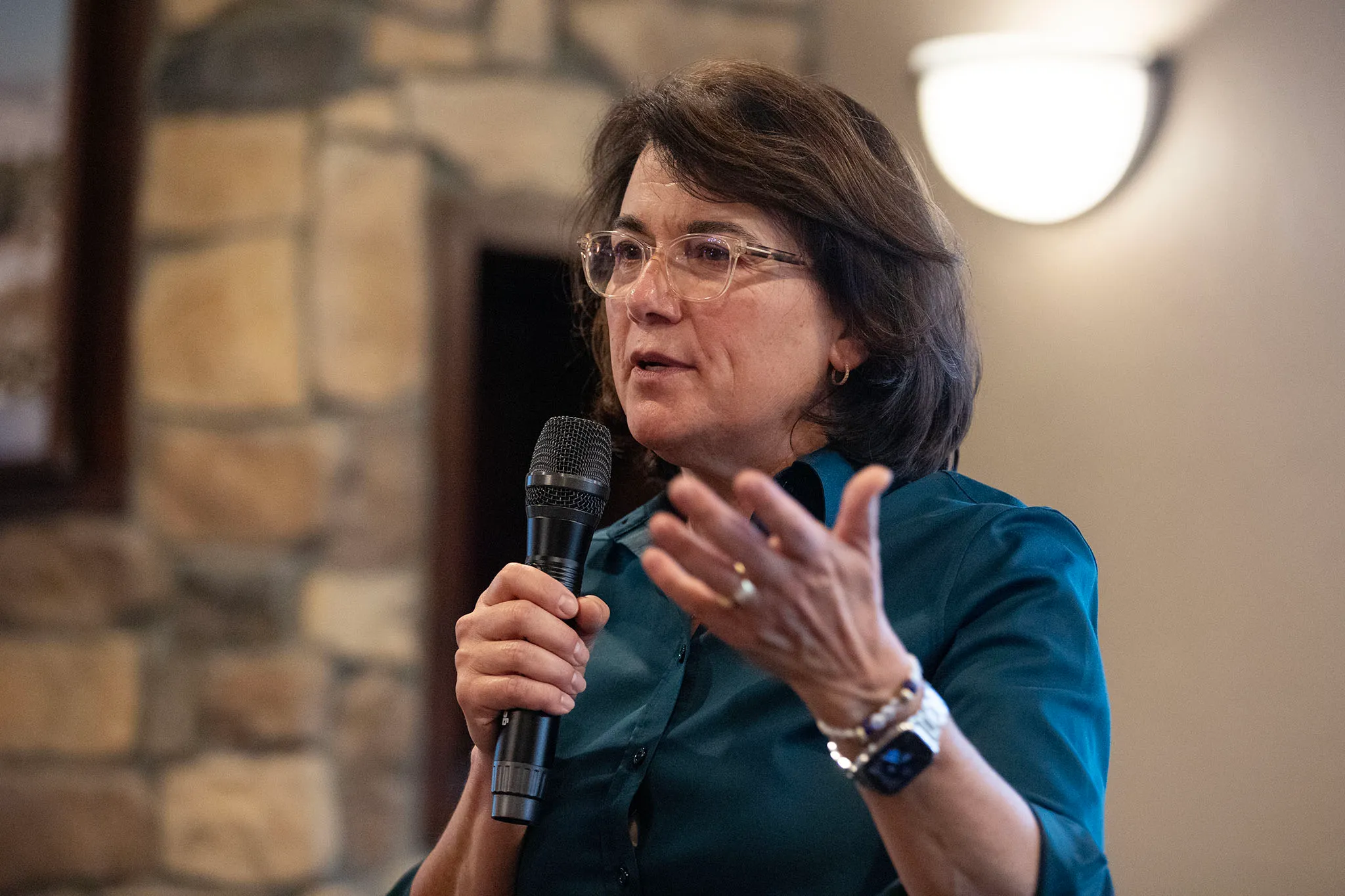
Democrat Eileen Laubacher takes a lot of notes.
“I think I’ve gone through about 20 notebooks,” she said.
Laubacher scribbles down details from her meetings with different organizations and the people she talks with as she runs for the 4th Congressional District seat, currently held by Republican Lauren Boebert.
Read more Clean energy driving good jobs, growth on Eastern Plains, study says
The retired Navy rear admiral said she often flips back through what she writes, “and [I] think about, ‘okay, how are we going to make a policy out of this? How are we going to work to solve these problems?’”
The bigger problem Laubacher faces, however, is how she wins what is considered the state’s safest Republican seat. There are more than twice as many registered Republicans as there are Democrats in the district, although almost half of the registered voters are unaffiliated. The last time the district elected a Democrat was in 2008, when Democrat Barack Obama was at the top of the ticket.
This story was produced as part of the Colorado Capitol News Alliance. It first appeared at cpr.org.
“Showing up in person is more important than anything,” she said during a campaign swing in the Eastern Plains. “You have to be there to have the conversation. You have to look people in the eyes.”
The district is made up of 21 counties, including all of the Eastern Plains and Front Range counties such as Douglas, Larimer, Weld and Adams. It’s about 38,000 square miles. Since starting the campaign last spring, Laubacher said she’s traveled 28,000 miles in the district.
While the majority of the population is in those Front Range communities, Laubacher has made a point of reaching out to rural Coloradans.
“Traveling around this district has made me realize that rural America needs champions and needs people who will fight for them,” she said, adding that the people she meets in rural Colorado tell her elected officials rarely show up, listen or care about what’s happening.
From the Navy to Congress?
Laubacher comes from a Navy family. Her grandfather was a frogman during World War II. Her father served. She served in the Navy Reserve and U.S. Navy for 34 years, and her son is currently in the Navy.
She and her husband fell in love with Colorado and moved here almost 30 years ago, raising their family while she served. She deployed to Afghanistan. She served as the defense attaché at the U.S. Embassy in India, and was a senior director at the National Security Council during the Biden administration.
Still, she said she never intended to run for Congress. But the former Republican turned unaffiliated voter decided early last year to run as a Democrat.
“I just felt called to try to make a difference. I wanted my kids and my grandkids to know that in this time I was willing to do something uncomfortable and difficult and scary to try to make this country a better place,” she told CPR News.
She said it seems that many people in Congress “want to become rich or internet famous.”
“That is not the job. I believe the job description [is] in the title: representative,” she stated.
“I think that people are hungry for real leadership and people who really care about them.”
She wears a beaded bracelet on her wrist made by her granddaughter and daughter that spells out “Eileen for Congress,” along with her grandfather’s St. Christopher medal, patron saint of travelers, as she undertakes this journey.
Meeting voters and the challenges of rural Colorado head-on
There’s yellow caution tape stretched across the front of the doors leading to the operating room right off the main hallway and across the corner from the ER at Lincoln Health Community Hospital in the small town of Hugo, located about 100 miles southeast of Denver.
Laubacher listened and asked questions as staff showed her around. They talked about emergency services, maternal health and the orthopedic surgeries they started doing there a few years ago. And of course, they talked about funding, in particular the looming Medicaid cuts passed in the Republicans’ signature tax and spending bill last year, known as the One Big Beautiful Bill Act or the Working Families Tax Cut.
“In the math of Washington, it’s estimated that across the country there’s going to be about $150 billion in cuts that rural hospitals will take in. So, they gave us $50 billion to try to offset that,” hospital CEO Kevin Stansbury explained to Laubacher. The money Congress allocated to offset the coming cuts is known as the Rural Health Transformation Program. “And then in their wisdom, they said, ‘But you can’t use any of that money to replace lost revenue. You have to strictly look forward. You can’t support existing programs. We want you to create new programs.’”
Laubacher, who’s visited 10 of the district’s 14 rural hospitals, replied that she’s heard these same concerns at other hospitals, too.
“A lot of times people think that the rural hospital is like a smaller version. And I’d say, no, actually I think the problem is magnified because every doctor that you lose, every nurse that you lose, every teacher that you lose has an outsized impact there,” she said.
These are not Republican or Democratic issues. They’re a rural America problem.
She wants to be a fighter for rural America.
Despite the dysfunction of Congress, Laubacher said she’ll work to find like-minded lawmakers on both sides of the aisle, facing these same challenges, and work on solutions.
“I think one of the things that frustrates me so much is people say, ‘Eileen, this is all great, but you’re going to go to Congress and you’re not going to be able to get anything done because no one ever does anything in Congress.’” She countered, “And I always think to myself, ‘Well, not with that kind of attitude, you’re not.’”
Laubacher often refers to her time in the Navy, where on ships you had to make do with what you had and ‘MacGyver’ what you didn’t. She’s banking that her can-do attitude will help her in an area of the state where Democrats have lost ground.
At the Sand and Sage Round-up Parade in Lamar on a sunny, hot Saturday morning, Laubacher handed out candy to kids, sometimes lagging behind her banner as she stopped to talk with voters and then ran to catch up with her team.
She said being here and talking to people can translate into votes. She said at a parade in Logan County a lifelong Republican came up to her.
“We had this great long conversation talking about all kinds of things. Costs, Iran, you name it, smaller government, national debt, things that I’m also passionate about,” she recalled. “Things that are gravely concerning to me. And at the end of it, he was like, ‘Yeah, all right. You’re my person.’ And I said, ‘Well, I really appreciate that, but I need you to do me a favor now. I need you to tell your neighbors, and I need to talk to people about me.’”
She’ll need that to happen a lot if she has any hopes of flipping the seat.
Boebert beat her Democratic challenger by almost 52,000 votes in 2024. And Republicans from the area aren’t worried.
State Sen. Rod Pelton, who represents a large chunk of the 4th District, said, “There’s a lot of Trump support out here.” Ty Harmon, a Prowers County commissioner, said Boebert’s “very well liked throughout the entire Southeast Colorado region.”
Why Democrats think the seat could be in play
There are a few reasons, however, why Democrats are bullish about the 4th District.
After switching districts, Boebert, who’s been a controversial figure in Colorado politics, won by 12 points. It was a solid win. But the previous representative, Ken Buck, won by 24 points.
Laubacher’s fundraising, which at the end of June totaled $10 million with more than $3.5 million cash on hand, dwarfed Boebert’s $1 million total, which included only about $250,000 in the bank.
Boebert also got on the wrong side of President Donald Trump after signing a discharge petition to release the Epstein files (a move many voters give her credit for). Trump vetoed her bill that extends the funding timeframe for the Arkansas Valley Conduit, and earlier this year sent out an insulting post on X fishing for a possible Republican challenger against her.
The firebrand Republican had a close call before, winning by only 546 votes in 2022 back when she represented the 3rd Congressional District.
But the real reason Laubacher may have a chance is the economy and Trump’s sinking approval rating.
“We put our trust in Trump and in his promises that he was going to carry farmers through, and he failed,” Zaiden Wertz told Laubacher at a candidate meet-and-greet in Lamar. “He really did fail. And I think that we would consider ourselves right-leaning, but we can’t be that way. We can’t be married to a party anymore.”
Wertz is a registered Republican who voted for Trump but now regrets it, adding that she’s not comfortable with either party right now.
Her husband Caleb, an unaffiliated voter, talked about how increases in diesel prices have hit their bottom line. In January they bought 4,000 gallons at around $2.20 a gallon. In April, after the start of this year’s Iran War, when the Wertzes needed to buy more, it was $3.75 a gallon. He said when you’re buying 8,000 gallons, it makes a dent.
“My uncle used to say a farmer makes better money under a Democratic president than a Republican. And I don’t think I can deny it anymore. And that really sucks because I don’t know that I can get on board with anybody at this point and I don’t know where that leaves me,” he said.
These are the voters Laubacher needs to flip, and Boebert, who they both voted for last cycle, needs to keep.
For Jensen Stulp, a 3rd generation farmer in Lamar who hosted the meet and greet, it’s about finding a candidate who won’t fight extremism with extremism.
“About 90% of everyone want change, need change,” he said, pointing out he invited Democrats, unaffiliated and Republican neighbors to meet Laubacher. “We need a politician that doesn’t identify with the extreme. We need a politician that will represent basically the middle 90. And there’s a lot of us.”
Showing up and talking to people, even those you don’t agree with or agree with you, is appreciated in this crowd.
“Her opening comments was [were] very encouraging. It’s nonpartisan, and that’s always a plus in my opinion,” said Steve Shelton, a Republican farmer and rancher, who voted for Donald Trump. He said he wants a representative with common sense. “That’s hard to find in a politician. They start with common sense, but it seems like they kind of start tipping the other way.”
Laubacher acknowledged that flipping the seat won’t be easy.
“I firmly believe that all things that are really worth doing in life are hard,” she said.
This story was produced by the Capitol News Alliance, a collaboration between KUNC News, Colorado Public Radio, Rocky Mountain PBS, and The Colorado Sun, with support from news outlets throughout the state. Startup funding for the Alliance was provided in part by the Corporation for Public Broadcasting.