 By admin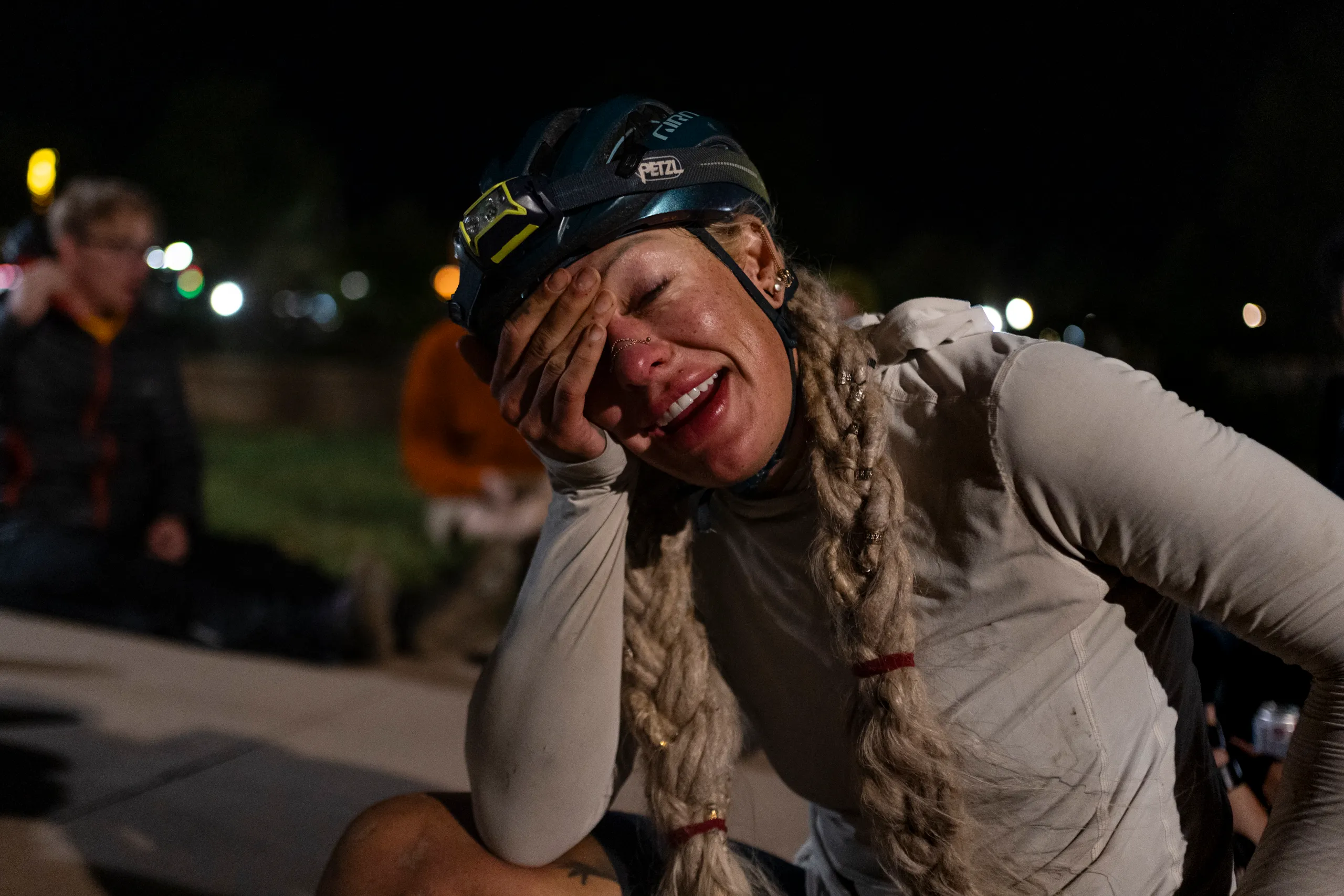
FORT COLLINS
The start line is a crack in a basketball court. The racers, 36 out of nearly 70 who signed up, parked their loaded bikes along the line at 7:21 a.m. on Aug. 28.
Read more Colorado just made it easier to get a COVID vaccine this year
They arrived from California and Arizona, but mostly other towns in Colorado, some sleepy, some jittery, some slightly hungover from a welcome party the night before. All are ready to tackle the 643-mile route from Fort Collins to Trinidad during the sixth annual North South Colorado bike race.
With the cyclists lined up facing east into the sunrise, Al Parks, North South co-director, took his place at center court for a prerace meeting:
Don’t leave trash.
Don’t start a fire.
The post office in Granby will look like a nice place to sleep tonight.
It’s not.
“That’s based on experience,” Parks said about the last point. Meeting adjourned.
Then he backed off the court and gave them their cue.
On your marks, get set … just kidding.
“It’s 7:30 so you can start riding your bikes now if you want,” Parks said.
And off they went.
North South Colorado is a grassroots, self-supported gravel race, a subgenre of the cycling discipline — gravel racing — that has grown so large over the past decade that it has splintered into subgenres.
Gravel racing has overtaken the vaunted position that road racing held for a short but intense period in the early 2000s. These days, gravel racing is where the fans are, brands are, and increasingly where you can find the best bike racers in the country — often competing for little more than a couple bucks and some social media footage.
Companies like Life Time, which runs a national chain of massive, multistory fitness centers, caught onto this a while ago, and transitioned their events arm away from triathlons and into the endurance space. In 2010 the company acquired the Leadville 100 series, in 2019 they picked up Unbound Gravel, a 350-mile loop that starts and ends in Emporia, Kansas. They produce about a dozen races on dirt these days.
The company’s entrance into the sport made a big splash. Was it casting a corporate shadow onto a scrappy scene, or broadening access and expanding opportunities in the sport? Depends on who is answering. Either way, Life Time pulled focus and injected the sport with a status that it hadn’t yet realized.
But the sport’s broad appeal isn’t just about the big names and marquee races. Gravel race organizers have largely rejected the exclusivity that once made road racing such a spectacle, but kept the vast majority of its fans on the sidelines. The whirr of whippet-thin road racers bombing down hills and cutting through cobblestone streets in France is a thrill to watch — but grinding along a wide open county road with a bag full of snacks and sunscreen is a lot easier to actually get out and do.
Instead, there’s an explicit culture, what some refer to as the “spirit of gravel,” that strips away the pretensions and focuses on people who want to ride really far.
Most cyclists who sign up for a race like North South won’t finish it. Over the race’s previous five runs, 78 people have completed the race and 86 have dropped out somewhere along the way. Which to the right kind of person is part of the race’s appeal.
So while there will always be folks gunning to finish first, most participants aren’t racing each other out there. They’re figuring out how far they can push themselves, sometimes literally pedaling days longer than they’ve ever gone. And then turning around and seeing if next time, maybe, they can go a little bit farther.
It’s going to hurt
“It’s like a drug,” Mayella Krause, a Brazilian rider based in Boulder, said just a few days before lining up for North South.
Krause recounted her first attempt at the Iditarod 350, a rugged race in Alaska in March, when temperatures rarely crest zero, during which she crossed a frozen river in the middle of the night, certain that was where she’d die; during which she pushed her bike for 25 hours straight to the highest point of the Iditarod because the stitching of her pants was cutting into her and she couldn’t sit down; during which her thermos broke and she lost access to her water on the trail. She cried, she screamed at the sky, then she went back and did it again the next year.
“And different problems arose because there were different conditions,” Krause said about her next attempt. “So it’s this constant game of having problems thrown at you, and you have to just be creative to get it sorted out. It’s addicting.”
(This year Krause was one of four Iditarod 1000 winners who crossed the finish line together, completing the full 1,000-mile route from Anchorage to Nome in 27 days.)
Krause might represent one end of the spectrum of extreme, but everyone who signs up for these races is consenting to meet their demons at some point along the ride. You don’t make it through 650 self-supported miles in the mountains unscathed. Arriving at the finish is a mix of physical capability, mental strength, preparation, creative problem-solving and plain luck.
As North South approached this year, word got out that Lachlan Morton, a professional cyclist who has become a poster child for mega-endurance rides and fastest known times, would be competing this year. The organizers fretted a little — it’s harder to keep a race low-key once someone like Morton has put his stamp of approval on it.
Besides his hot pink EF Education-EasyPost kit and matching hot pink helmet, Morton basically blended in with the rest of the riders Friday. He didn’t sprint to the front when Parks gave the go, he sat back and leisurely pedaled into the middle of the pack. Before they hit the 20-mile mark he’d opened up a 2-mile gap between himself and the other 35 riders.
Later that night, just before midnight, Morton’s bike broke coming down Rollins Pass. He limped into Rollinsville at 12:30 a.m., posted a video to Instagram — “saw three moose, saw a bear climb up a tree next to me. So I still had a good day,” he said to his phone — and withdrew from the race about a third of the way through despite a 20-mile lead.
When you’re riding on the edge, even a shift in the wind can tip a race. Or it might be a broken bike or a bout of bad weather, it could be a crash, a flat, a poor night of sleep. By the 48-hour mark of North South almost one-third of the riders had dropped out.
But the opposite can happen, too. Riders might spend hours grinding through a bum knee or a bad stomach or a stretch of dark thoughts, and then the sun will rise. Or they’ll emerge above treeline. Or a cooler full of ice-cold Gatorade from friendly strangers appears, and everything changes.
“There are people who are truly suffering, with hunger, violence, things that are just incredibly brutal. And then I look at myself,” Krause said. “Yeah it’s painful, but I am willingly choosing to go through these things just to overcome the challenges. And I still have not really found the word that substitutes for true suffering, but also does not diminish how challenging these things are.”
All access
At a Maverik gas station in Idaho Springs, 250 miles into the race, Gregg Dunham emptied his bike bags onto the sidewalk and pulled up the calculator on his phone. He held up each snack and plugged in the calorie count, trying to make sure he has about 200-300 calories per hour on the bike.
Then he headed into the store. He grabbed a pack of Haribo gummy sharks — “these are always a favorite” — then spun around and reached for a Snickers Almond, and added 230 calories into his calculator. “Why is anyone else eating this stuff?” he laughed. “But I’m sure glad it’s here now. It just shouldn’t be this readily available,” he said, grabbing a second Snickers.
Back outside, he sat cross-legged on the sidewalk and cracked open a cold chocolate milk and a Red Bull. He drank the milk, opened a strawberry Chobani yogurt, took a bite of pizza then sipped on the Red Bull.
“It takes me awhile to eat all this, I can’t do it at once like some people,“ he said.
Read more Lauren Boebert’s son will spend at least 20 nights in jail
For most ultra-endurance events, “self-supported” is a bit of a misnomer. Riders can buy food on the route or even spend the night in a motel if they want. They can accept anything that is commercially available to every racer equally. In other words, there’s no crashing on a friend’s couch, unless that couch is open to all 36 dirty, bloody, sun-baked racers at any time of day. They can also accept “trail magic,” a cold drink or some cookies from strangers who know that the race is going on, but they can’t have a friend bring them a fresh pair of socks.
Figuring out where and when to refuel becomes part of the journey. Maveriks are a crowd favorite because they’re open all night. But one of the defining characteristics of gravel racing is that those gravel roads take you far from towns and traffic, which means the beacons of 24-7 access to spicy chicken sandwiches are few and very far between.
Dunham finished his pizza and hunched over his phone, scoping his next 100-mile push to Manitou Springs, where he was hoping to sleep for a few hours. A Maverik employee walked by and told Dunham about some picnic tables around the corner.
“I’m about to leave right now,” Dunham said, corralling his calorie pile into a neat little mound.
“You’re perfectly fine. It’s just, sitting on the ground, it seems uncomfortable,” the employee said. “Seems just way too hard on your body.”
Crowded gravel roads
As far as gravel races go, North South is relatively tapped into major infrastructure — the longest stretch without food is just over 100 miles between Fort Collins and Gould.
Those hoping to race elsewhere in the state often have to load their bikes a little heavier, or rely on the race organizers to have arranged extra opening hours with local gas stations and general stores.
Britt Batterton, for instance, a respiratory therapist in Greeley who organizes the 330-mile High Plains Drifter, begins his race prep by calling around towns to make sure their spigots are on. He calls the church in Carr and the café in New Raymer to let them know that riders will be stopping for water, then hits up the mayor of Grover to ask him to keep the bathrooms open in the park.
Batterton started High Plains Drifter in 2020 as a way to get people out onto what Batterton called the B roads, unmaintained county roads, while staying close to home. “They’re a lot of fun to ride,” he said about the B roads in Weld County. “They’re a little rougher and funner on a bike. And, you know, there’s no traffic.”
Getting people off the pavement accounts for at least some of the sport’s appeal, especially for women and nonbinary riders who have historically been elbowed out of mainstream cycling.
Since Batterton started High Plains Drifter, he and his wife have run the whole show from start to finish. There are no fees to sign up and no prize money to win. He prides himself on greeting every finisher, no matter what time of day, with a hand-rolled breakfast burrito and a cold Coke.
“It’s important to me to keep it affordable, attainable and just a fun atmosphere,” he said. “If people want to be competitive they sure can. But if they just want to go out and ride some roads in some areas they’ve never been to, then that’s what it’s about, too.”
Then you’ve got the Life Time Grand Prix, a six-race series that includes Leadville and Unbound. The Grand Prix debuted in 2022 with a hand-picked roster of 60 athletes — 30 men and 30 women — competing for $250,000 in prize money. That prize purse has since been upped to $350,000, with winners taking home $50,000 each.
Taken at face value, a series like the Grand Prix looks antithetical to grassroots races like High Plains Drifter and North South — but to a certain extent one doesn’t exist without the other.
Life Time’s social media channels do numbers. This year’s livestream of Unbound Gravel — 11 hours straight of bike racing — has more than half a million views.
“The idea of putting bike races in the palm of people’s hands on their phones, or on the screens in their living rooms, that’s a big focus for us,” said Kimo Seymour, president of events and media for Life Time. “People like that content, and it’s indirectly created more demand for the events that we have. It’s been a worthwhile investment.”
And sure, half a million views on YouTube is nothing compared with the millions showing up to cheer at the Tour de France (and the millions more tuning in from around the world). But when the Tour is over most of those viewers remain viewers, just like most soccer, baseball and basketball fans aren’t playing in leagues of their own. What Life Time knows is that when the Grand Prix is over, many of those viewers are going to get out and ride their bikes.
“Gravel has more in common with a marathon running event than the Tour de France,” Anne-Marije Rook wrote in Cycling Weekly. “No one judges the health of a marathon by television ratings. The world’s biggest marathons are successful because hundreds of thousands of people want to take part year after year after year. Broadcasts exist, but participation is the engine.”
While Life Time acquires and ramps up grassroots races (Seymour said the company is always scouting, but more focused on its current races right now), the bulk of its fans aren’t shelling out $345 and entering a lottery to line up among the best. Most are out looking for the North Souths and the High Plains Drifters, in it for an epic trek and the camaraderie of suffering.
“At the end of the day, everyone’s out here for the challenge and for the adventure. So it’s cool to see pros doing a discipline they haven’t been training for,” said Austin Breunig, a North South racer, as he made his way up Rollins Pass about 17 hours after Morton broke his bike descending it. “They’re just like everybody else, they’re just faster.”
112 hours later
At 11:38 p.m. Tuesday night, Krause rode into Cimino Park in Trinidad, the race’s official finish line, four days, 16 hours and eight minutes after leaving Fort Collins. Parks handed Krause $3 for winning the women’s race and took her photo on the dark sidewalk.
She laid her bike down, took her shoes off and cracked open a can of Pabst Blue Ribbon. A second racer, Ian Nomura, rode in about 10 minutes after Krause. Two riders who finished earlier in the day joined the tiny park celebration, wearing matching Trinidad shirts that they bought to get out of their dirty cycling kits.
This story first appeared in Colorado Sunday, a premium magazine newsletter for members.
The group sat in the grass for an hour swapping stories about where they slept (behind an abandoned house, in a post office, in a pit toilet, at a casino, in a restaurant booth), what they saw (or didn’t see — Krause hallucinated her way up Mammoth Gulch, a climb just west of Nederland) and how they felt (a strange mix of symptoms that would concern almost anyone who hadn’t just ridden a bike 650 miles).
Krause’s bike broke twice on the route but she managed to put it back together. The first time she got help from a bike shop in Winter Park, the second time by disassembling and reassembling it at the post office in Idaho Springs. “If I finish the race it will be just out of rage,” she posted to Instagram after her derailleur, which changes the gears on a bike, broke a third of the way into the race.
But at the park in Trinidad she was all dirt, smiles and PBR.
“Net positive,” she said, leaning back on her hands. “I didn’t cry a single time.”
Read more Colorado-wide student protest against ICE turns violent in Denver