 By admin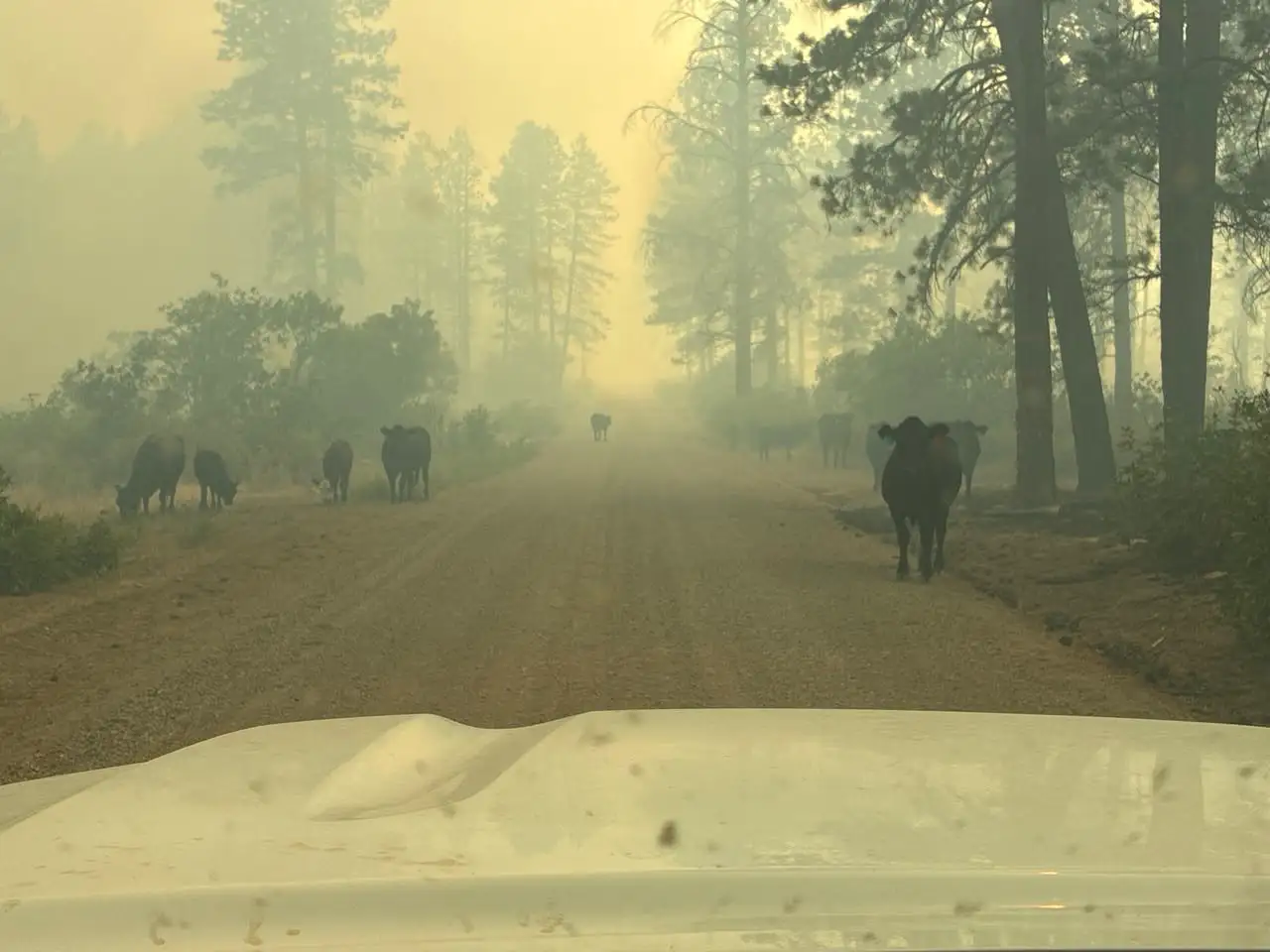
As the sun dipped below the horizon behind him, Andrew Bowles watched an orange glow barely visible over the ridge flare into what looked like a milelong wall of 100-foot-tall flames.
Read more Boulder County commissioners back off plan to limit mountain bike access at parks around Lyons
“You anticipate the worst,” Bowles, the ranch manager of J Bar M Ranch in Ouray County, said in a phone interview Tuesday. “You think everything is trapped up there, everything you haven’t had a chance to get out. It was pretty emotional.”
That night early last week was when Bowles said he hit his breaking point. While the Gold Mountain fire roared closer, eventually stretching across more than 31,000 acres after starting June 27, he sat down on the ground and called his wife for a moment of comfort. He had spent the bulk of the past three days coaxing cows down from the high country to safety in an irrigated hay pasture.
A week later, all his cattle and horses are alive, but the wildfire burned almost a third of the ranch’s land and the future is as hazy as the sky above.
“This whole situation started out taking it day by day,” Bowles said. “It evolved into taking things hour by hour and it evolved from there to taking things minute by minute. I don’t really know what the future holds.”
As fires continue to burn across Colorado, ranchers in some areas cut fences to let cattle escape the flames. They’ve moved herds, on horseback or with their vehicles, in many cases, with the help of friends. They’ve pushed cows away from flames as fires moved close. And they have stayed up all hours trying to figure out what to do next with no certainty about when the last of the flames will fan out.
The losses are mounting, threatening the health of herds and the future of some ranches that have been passed down for generations. The immediate casualties have left ranchers devastated: Animals killed. Buildings and fences turned to rubble. Land scorched and covered in ash. Cows with long-lasting health impacts like burned respiratory systems. And thousands of acres of grazing land lost, which could force already drought-stressed ranchers to sell off cattle.
No one can say what the economic impact of all these losses will be yet.
“I would guess we’ll know more around 30 days out (from extinguishing the fires),” said James Pritchett, who oversees Colorado State University’s agriculture education outreach program and Colorado State 4-H among other things. “Because we don’t yet know what folks are doing in terms of relocating cattle or how many cows have had to be relocated or what the long-term effects of things like smoke inhalation and stress will have on herds.”
Ranchers activate a kind of telephone tree for help
The call for hay went out June 30, as livestock evacuated from the Aspen Acres fire began to arrive at the Colorado State Fairgrounds in Pueblo.
Sara Mayer, the membership coordinator for the Rocky Mountain Farmers Union, immediately started making calls. By that evening she had a trailer with 78 bales of hay waiting for her 150 miles north of where it needed to be, in Johnstown. She just needed to find a driver.
Mayer texted Dan Frazen, emergency coordinator for the Colorado Department of Agriculture, who got a hold of brand Commissioner Todd Inglee, who talked to the Colorado Cattlemen’s Association, who activated a kind of phone tag for help.
“It was like a weird game of telephone,” Mayer said. “But it was a good test run. It’s sad that it had to happen during an emergency, but it’s really cool to be like, oh, we can work together. And we ought to.”
When a wildfire begins invading a rancher’s property, options to save animals are limited.
A rancher can herd livestock onto trailers and drive them out of harm’s way — but it’s far from a simple or speedy process, said Travis Grant, CEO of the Colorado Livestock Association.
“You can only put so many head of livestock on even a 53-foot semitrailer,” Grant said, “and that’s assuming you’ve got the trailer readily available and the infrastructure and the time to load livestock and then haul them out and then you have (to have) a place to put them.”
Horses, calves and other livestock that tend to spend their days closer to ranch headquarters and are easier to load are generally more likely to get a spot on a trailer, he said.
Otherwise, as wind shifts and weather changes leave ranchers making their best guesses about which direction a fire will take, they cut their fences so livestock have a better chance of fleeing on their own.
“Livestock is only gonna move so fast, and if the fire is moving as quickly as sometimes we’ve seen with this Aspen Acres fire, they may be moving to get away and still be swallowed up by it,” Grant added. “Ranchers are gonna give their livestock the best possible chance to survive and then hope and pray, really, once you’ve done everything you can do on the ground.”
“It all culminates in a lot of stress,” Grant said, “and that just piles on an industry that already is facing pretty serious mental health challenges.”
Programs like AgWell, run through the Rocky Mountain Farmers Union, have been called in to help farmers deal with mental, social and now financial hardships. AgWell runs AgAssist, a fund it started about two years ago, right before AgWell’s funding from the U.S. Department of Agriculture was slashed. The fund is slim and entirely reliant on donations, with around $2,000 banked at any given time.
“We’re trying to spend that out, we’re trying to make sure people get what they need,” said Mayer, the membership coordinator for the Rocky Mountain Farmers Union. “But if the ask is for 30 grand, I definitely can’t help you with that.”
Fire impacts on cattle, ranchers
Wildfires impact livestock health in immediate and long-lasting ways.
Some cattle on the Western Slope have died in flames, while others have suffered internal injuries, Pritchett, of CSU, said. The stress from fire can negatively affect bulls’ testosterone count, so conception rates may go down. And calves born to stressed cows have lower birth weights, he said.
Read more Supreme Court will hear Nebraska’s fight over access to Colorado’s South Platte River
Dehydration is a factor. As are lacerations if a rancher is forced to cut fencing to let cattle escape. Smoke inhalation damages their respiratory systems. “Breathing in superheated air can burn and slough off airway tissue,” Pritchett said. And scorched earth can damage hooves, leaving the cows with mobility problems.
Cattle prices are decent right now, thanks to low inventory and high demand across the United States. But the drought has made it extremely hard to find hay, Pritchett said, and wildfires will only exacerbate the problem.
“So I think the effects from the fires will be longer lived than what people expect,” he said. “And it goes beyond just mortality, because we don’t yet know what folks are doing in terms of relocating cattle or how hard it’s going to be to access feed and supplies.”
Smaller fires have resulted in relatively low numbers of ranchers having to relocate, he added.
But if all of the wrong factors combine, it could lead to ranchers having to sell off cattle to survive. “And for those that have a breeding herd, that could negatively impact the genetics that they’ve worked so hard to build. So they’ll be liquidating not just inventory but also a part of the business itself, and that will negatively impact their overall ability to service any debt they have.”
Bowles, the ranch manager in Ouray County, worries about what his cattle will eat come winter. When the wind changed direction last week, bringing a stroke of luck that kept the fire at bay, J Bar M Ranch dodged the worst case scenario. Still, about 3,000 acres of the 10,000-acre ranch have burned, including most of the high country where his 300 cows graze on what he calls “the good grass.”
Now those cows are gnawing on the hay the ranch grows all summer – hay that ranch hands would normally be cutting, raking and baling this time of year — to feed them during the winter.
“If there’s no hay to put up, then there’s no hay to feed in the winter,” Bowles said, “and if there’s no hay to feed in the winter, then there won’t be any cows.”
He is confident the ranch will survive, even if it no longer feels like a ranch. Gone are many of the trees and much of the foliage, and it’s hard to say when new life will begin sprouting.
In the meantime, he has a safety net of people helping him tend to the animals and the land. Neighbors and their dogs have stepped up to escort cattle down hills. Firefighters have constructed fire lines and defended structures, homes and hayfields, catching sleep in sleeping bags in a gravel parking lot or in tents on the ranch.
Cowboys don’t readily accept help, Bowles said, but he has learned to lean on those extending a hand for the sake of his livestock.
“These cattle are our livelihood,” he said. “We don’t eat and we don’t drink until our horses and cows have, and that mindset hasn’t changed through any of this. If anything, it’s been even escalated, our beliefs and values in how we care for our livestock and our animals.”
Leaving cattle close to Ferris fire
Pritchett said he doesn’t know how many cattle have burned in this summer’s fires because “some people had to just get out of there as fast as possible.”
But leaving cattle where they are is working well on the Glade in the San Juan National Forest where the Ferris fire is burning near Dolores. That’s because firefighters were able to get ahead of the flames and contain them behind a reinforced fire line that’s currently protecting several thousand acres, said Lorena Williams, public information officer for the San Juan National Forest.
The Glade refers to 165,000 acres on a plateau above the Dolores River with deep canyons cutting through it, Williams said. It supports more cattle than any other area in the forest, and not only cattle. The San Juan forest supports around 23,000 elk and more than 70,000 deer. And Williams said herds gather to forage on the grassy meadows there.
Seven ranchers also run 2,300 cow-calf pairs on grazing allotments, “so cattle permittees are being heavily, heavily impacted by the size of this fire,” Williams said. (The Ferris fire had burned more than 51,600 acres as of Tuesday.)
But early on, U.S. Forest Service officials including a range liaison and ranchers themselves decided they could keep cattle on the land with enough coordination and by moving them around.
“The Glade is a big, open flat where the cows can get out of the way, and the ranchers just push them to different areas,” Williams said.
They do have to contend with the fire, however. “There are several flanks of this fire that are actively burning right now, and we’re just moving the cattle in advance of it,” she added.
They’re able to predict where it’s going based on “pretty good fire modeling that allows us to anticipate what will happen, so we plan accordingly with the permittees,” Williams said. “And — just a fun fact — one of them has virtual (fencing) so he can just get on his cellphone and move his cows without ever stepping foot on the forest.”
Read more 10 Colorado drinks to toast 150 years of state history