 By admin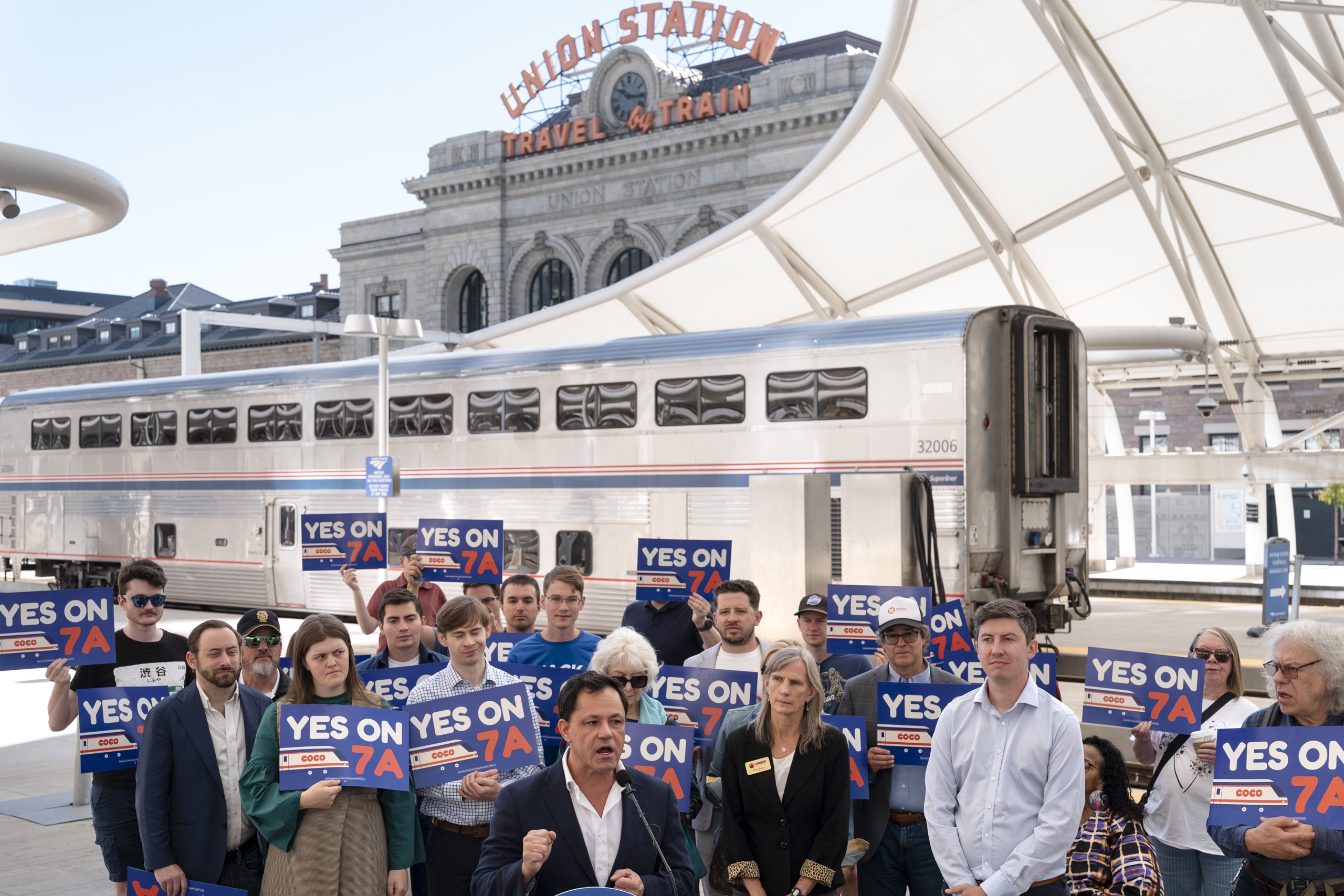
The Colorado Secretary of State’s office is telling Adams, Arapahoe, Douglas and Weld counties to reconfigure their voting systems so that only eligible votes on the passenger rail ballot question are counted in the November election.
Read more Nederland is seeking state funds, donations to complete purchase of Eldora Mountain Resort
The guidance issued late Wednesday comes after the Front Range Passenger Rail District, the special tax district created to raise money for a Front Range passenger rail system, learned 800,000 voters outside of the district received Ballot Issue 7A on their ballots by mistake.
The ballot question asks voters near planned train stations whether they want to tax themselves to pay for expanded and more frequent passenger rail service along the Front Range.
In a letter to the four affected counties, Judd Choate, the director of elections at the Colorado Department of State, said in most cases counties should reconfigure their systems to exclude ineligible votes on 7A.
“Please program your voting systems (Liberty Vote or Clear Ballot) to count Ballot Issue 7A for only eligible voters in the district,” said the guidance. “Testing the system configuration will be an important step in this process, and our team will send supplemental testing protocols to you later this week.”
In most cases, the voting systems will be able to differentiate between a ballot that should have the 7A question and a ballot that should not, Choate said. In at least two jurisdictions, Bow Mar in Arapahoe County and Sterling Ranch in Douglas County, there are eligible voters and ineligible voters, complicating the process. In those cases, ballots will be hand reviewed, Choate said, to only count eligible votes on 7A.
It’s not clear how the extra steps will affect the timing of final election results on Nov. 3.
The confusion about which voters are eligible to vote on 7A stems from a change to the Front Range Passenger Rail District made by state lawmakers earlier this year. Lawmakers trimmed out many parts of the district, leaving residents in only certain portions of some counties eligible to vote on the tax increase.
What would a sales tax increase to pay for a Front Range passenger train cost you?
Ballot Issue 7A would add a 0.333% sales tax in the Front Range Passenger Rail District — about 33 cents on every $100 of taxable purchases. Enter what you spend in a year to see the added cost.
Read more A Vail mountaineer is vying to be the first American woman to scale the world’s tallest volcanoes
Everyday taxable purchases — not rent, most groceries, or other items exempt from state sales tax. Drag the slider or type an amount.
How this works: Ballot Issue 7A would add 0.333 percentage points — about 33 cents on every $100 — on top of the state and local sales tax you already pay. It applies only when you buy something inside the Front Range Passenger Rail District, or when someone who lives in the district buys online. (Calculator created by Jesse Paul, The Colorado Sun)
Adams County spokesperson Julie Jackson said the county was not notified about the change prior to mailing ballots.
“Our job is to provide Adams County voters with secure and transparent elections, according to the law, and this issue will not affect that mission,” she said in a statement. “It’s important our voters know they can still complete and return their ballots, and our office will ensure every valid vote is counted.”
Sal Pace, general manager of the Front Range Passenger Rail District, the group behind the ballot measure, said the group should have communicated more effectively with the counties about the change.
The ballot question will determine the future of passenger rail service in Colorado.
Limited passenger train service between Denver and Fort Collins is already planned to start in 2029 with just three daily round trips.
Ballot Issue 7A asks about 2.4 million voters in about that would be served by the rail service to approve a new 0.333% sales tax — amounting to about 33 cents on a $100 purchase — to pay for more frequent service with a stop as far south as Pueblo aboard a train recently named the Colorado Connector, or CoCo.