 By admin
On one hand, state election officials say the likelihood of federal immigration officers stalking polling places on Election Day, scaring away voters in an attempt to influence the election is remote. On the other, some have been preparing for that possibility.
Read more New Castle man, two sons killed in crash of small plane
In Denver, which has gone to court to try to block U.S. Immigration and Customs Enforcement officers from voting locations, election workers are being trained to watch out for immigration officers, document their presence and de-escalate any interactions with them.
Boulder County’s clerk is asking voters who see ICE officers at voting places to alert her office or call 911 if they feel unsafe.
“Our approach is to de-escalate and redirect the situation to ensure that voting continues to happen in a manner that supports voters and reduces harm and the risk of violence,” Clerk Molly Fitzpatrick, a Democrat, said in a social media video, joined by Boulder County Sheriff Curtis Johnson and District Attorney Michael Dougherty.
In Eagle County, officials have been addressing questions about ICE as part of the overall training for election workers that includes how to respond to emergencies, delays and complications like blizzards or wildfires.
Election officials, particularly Democratic ones, say they want to be prepared for anything and respond to community fears and speculation.
They are also operating knowing that the Trump administration’s heavy involvement in immigration enforcement and in elections is unprecedented in recent American history, culminating with the attack on the U.S. Capitol on Jan. 6, 2021, an attempt to stop Congress from certifying election results.
“Our judges are civically minded and pay attention to current headlines, so addressing these topics is necessary. Our goal is simply to ensure they are fully prepared to keep voting smooth, neutral, and secure,” Eagle County Clerk Becky Close, who is unaffiliated, said in an email.
Colorado is unique in that the vast majority of voters — about 90% — don’t actually vote in person. Every registered voter gets a ballot in the mail, and most return it through the Postal Service or turn it in at a drop box.
That means even if federal immigration officers were to show up at polling places, only a small share of the electorate would interact with them.
Last month, U.S. Homeland Security Secretary Markwayne Mullin said ICE officers have the authority to go to polling places if there’s a threat to the location or if they’re serving a warrant on someone they have been actively tracking. He accused Democrats of “fearmongering” by expressing concern over ICE going to polling places.
After Denver joined with civil rights and voting groups to sue to make sure ICE officers didn’t show up at voting locations, the Department of Homeland Security said in a statement that ICE isn’t planning operations targeting polling locations. But it still left the door open to arrests happening at polling places if there was “an active public safety threat.”
Denver’s clerk, Democrat Paul Lopez, thinks it’s unlikely immigration officers will be at the polls in Colorado, since it’s not a swing state. Colorado has consistently voted blue in statewide races for more than a decade. But he does think ICE’s suggestion that arrests could happen is a “scare tactic” meant to discourage people from voting.
For any voter worried about ICE being at polling locations, Lopez suggests that they cast their mail ballot at one of the city’s many 24-hour ballot drop boxes. If there happens to be anyone hanging out around one, they can visit another one another time, he said.
“We have an intimidation-proof way of voting — it’s a ballot box,” he said.
Department of Justice gets involved
But while getting ready for the possibility of ICE showing up, election officials learned last week that the Department of Justice planned to send election observers to Adams County on Election Day.
The Department of Justice has said the monitoring is consistent with longstanding practice. Adams County was singled out because it is covered by a section of the federal Voting Rights Act that requires states, counties and cities to provide election materials, including ballots, in other languages if they meet certain criteria, such as having at least 5% of voting-age citizens who speak another language, department spokesperson Kiersten Pels,said.
Adams County has had to provide election materials in Spanish since it was added to the program in 2022, Adams County Clerk Josh Zygielbaum, a Democrat, said. Five other Colorado counties are currently required to provide materials in Spanish under the law — Alamosa, Conejos, Costilla, Denver and Saguache. Two are required to provide them in Ute — La Plata and Montezuma.
Back in 2022, under Democratic President Joe Biden, Zygielbaum said the Department of Justice’s Civil Rights Division reached out to the county to help it comply with the Voting Rights Act, calling it a “wonderful partner” then.
But now he is suspicious of the DOJ is coming to the Democratic-leaning county amid a tight race in the 8th Congressional District between Republican U.S. Rep. Gabe Evans and Democrat Manny Rutinel. The district includes part of Adams and neighboring Weld County, as well as a sliver of Larimer County. The race could help determine which party controls Congress.
Zygielbaum said making voting accessible to Spanish-speaking voters, as the Voting Rights Act requires, hasn’t been an issue there.
“The difference now is that they are not coming in a support capacity and the attorneys being sent are prosecutors,” he said Friday.
Read more Colorado thriller author Carter Wilson saves one creepy creation for his annual Halloween display
The DOJ notice to Adams County was sent by Jake Bachard, a trial lawyer with the Civil Rights Division’s Voting Rights Section, who offered to set up a virtual meeting with Zygielbaum to discuss their monitoring plans. He said the monitors would only observe.
“They do not intrude or interfere in any way with the voting process,” he wrote.
The Secretary of State’s Office has asked the Department of Justice to provide more details about what part of the voting process it wants to observe. In a letter to Bachard on Thursday, Deputy Secretary of State Andrew Kline said department observers would need the office’s permission to get access to secure parts of the process, like counting mail ballots.
ICE lawsuits
The lawsuit brought by Denver, the League of United Latin American Citizens, UnidosUS and Common Cause proactively asks a federal judge in Washington, D.C., to block ICE from being at voting locations after reports immigration officers made arrests in parking lots of polling locations in San Antonio, Texas and Ventura County, California, in May and June. Minnesota’s Hennepin County, home to Minneapolis, has also joined the lawsuit.
It claims that the Department of Homeland Security, which includes ICE, has established a policy allowing its officers to conduct enforcement operations at polling places. Allowing ICE officers at polling places, the lawsuit says, would violate a Civil War-era law that bans federal officials from sending troops or “armed men” to polling places. It was passed at the end of the war in response to the Lincoln administration’s practice of sending troops to border states to suppress votes for pro-Confederate or anti-war candidates. The only exception to the law is if the troops or armed men are needed to “repel armed enemies of the United States.”
Two other similar lawsuits have also been filed in federal court in Washington, D.C., one by the NAACP and other civil rights groups and another by Democratic Congressional leaders Sen. Chuck Schumer and Rep. Hakeem Jeffries, committees aimed at electing Democrats to Congress and the Democratic Governors’ Association. Besides violating the Civil War law, these suits argue that allowing ICE officers at voting locations would violate the Voting Rights Act’s ban on voter intimidation. A federal judge ruled Friday that the three cases should be consolidated and considered together.
Denver has not reported any ICE agents at its polling places, but is hoping to avoid any confrontations by getting a ruling from a judge.
If there was an instance where ICE officers were intimidating voters at the polls, the city would go to court to seek an emergency injunction to stop it, Jon Ewing, a spokesperson for Mayor Mike Johnston, said.
Under an executive order signed by Johnston earlier this year, the city’s police officers would have a duty to intervene to stop any “violent and unlawful behavior by ICE”, he said.
In a statement, the Denver Police Department said it would respond to any reported law violations at voting places, including those involving ICE, “with a focus on de-escalation” while relying on legal advice from the city’s attorney’s office.
Poll monitors
Just Vote Colorado, a coalition that recruits and trains people to serve as nonpartisan poll monitors, has seen an increase in people looking to help monitor voting because of concerns about whether there would be federal interference in the election, said Aly Belknap, the executive director of Colorado Common Cause, which is part of the coalition.
About 800 people have signed up to get training this year, she said. In 2024, the group had 300 volunteers.
Because of the fear of ICE being at the polls and the increase in immigration enforcement generally, the coalition is teaming up with the Colorado Rapid Response Network, which provides updates on ICE sightings and whether or not they were confirmed on its Facebook page, for this year’s election, she said. It’s telling poll monitors to report any ICE officers at the polls to the network. She said the network will let the coalition know about immigration enforcement near voting places.
In person voting centers in Colorado for the Nov. 3 election began opening Oct. 19 and so far no ICE agents have been reported anywhere in the state.
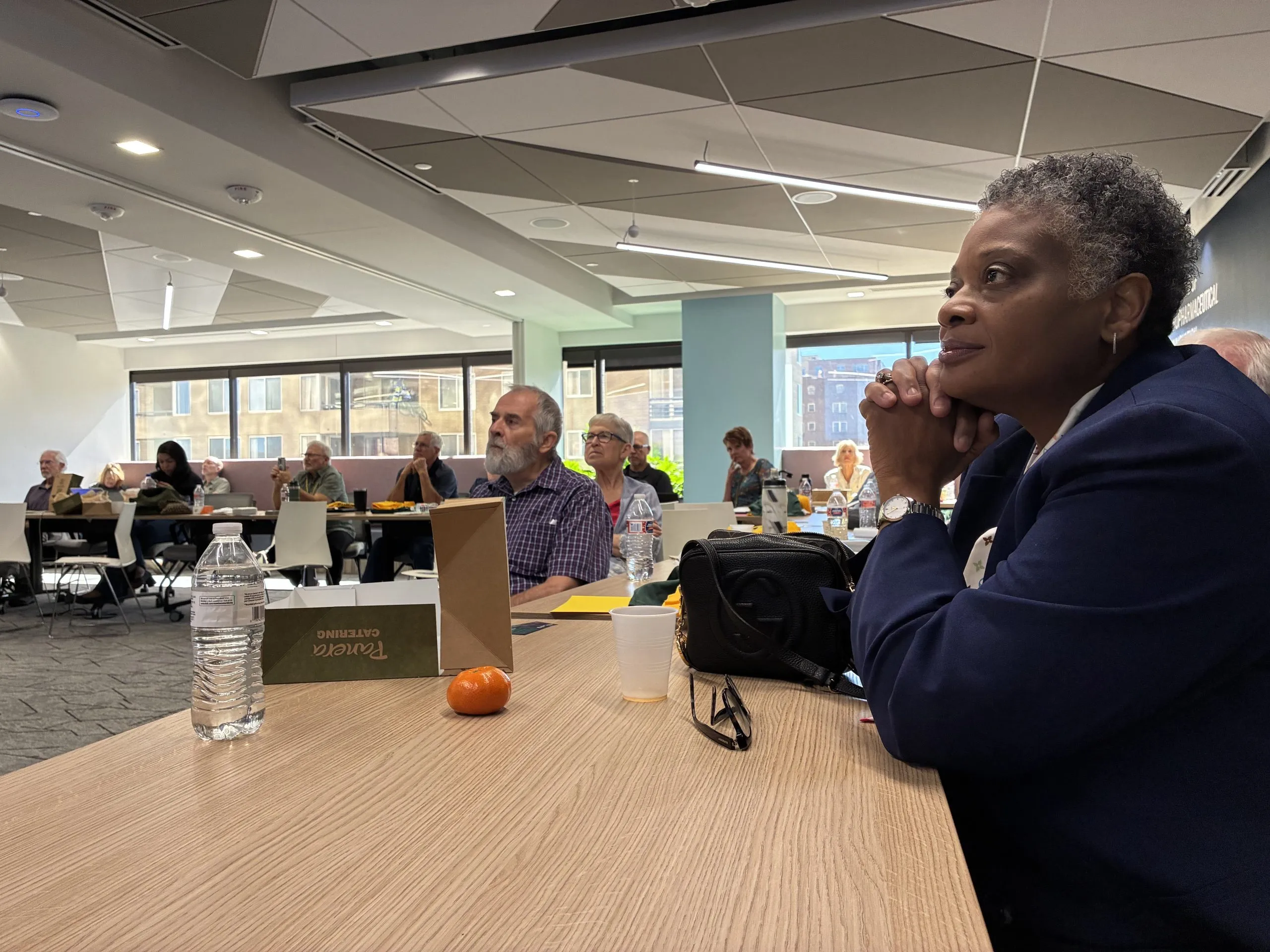
At a training for about 50 poll monitors in Denver earlier this month, Belknap said there was no credible evidence that ICE will be at the polls in Colorado. But she said monitors, wearing yellow T-shirts announcing their role, could still help anyone who was afraid of voting this year.
“Fear is the point to get people to not vote so we’re there to be the antidote to fear,” she told the group, which included many first time volunteers.
They included Rudy Garcia, a retired teacher from Denver who said he wanted to defend the voting process for both immigrants and people of color largely because of the surge in immigration enforcement.
He said he wonders whether people of Mexican descent who are citizens in his neighborhood might be hesitant to vote after months of immigration officers pulling people over doing everyday errands. He said people shouldn’t have to be afraid to do ordinary things, including voting.
“This is a crisis. It’s a political electoral crisis of everyday life in America now and we got to rise up. We got to defend each other,” Garcia said.
Vita Lantz-Brown, a retired nurse from Arapahoe County who has served as a poll monitor for over 20 years, plans to be stationed at a polling location on Election Day once again from 7 a.m. until polls close at 7 p.m. If there are still people in line when the polls close, she’ll be ready to order them pizza, as she has in the past.
Lantz-Brown, 60, thinks this is the most important election in her lifetime because, she said, democracy is at stake. She believes the Trump administration will use every tool it can to scare people not to vote, including ICE or Department of Justice monitors.
“I’m just going to be very alert,” she said.