 By admin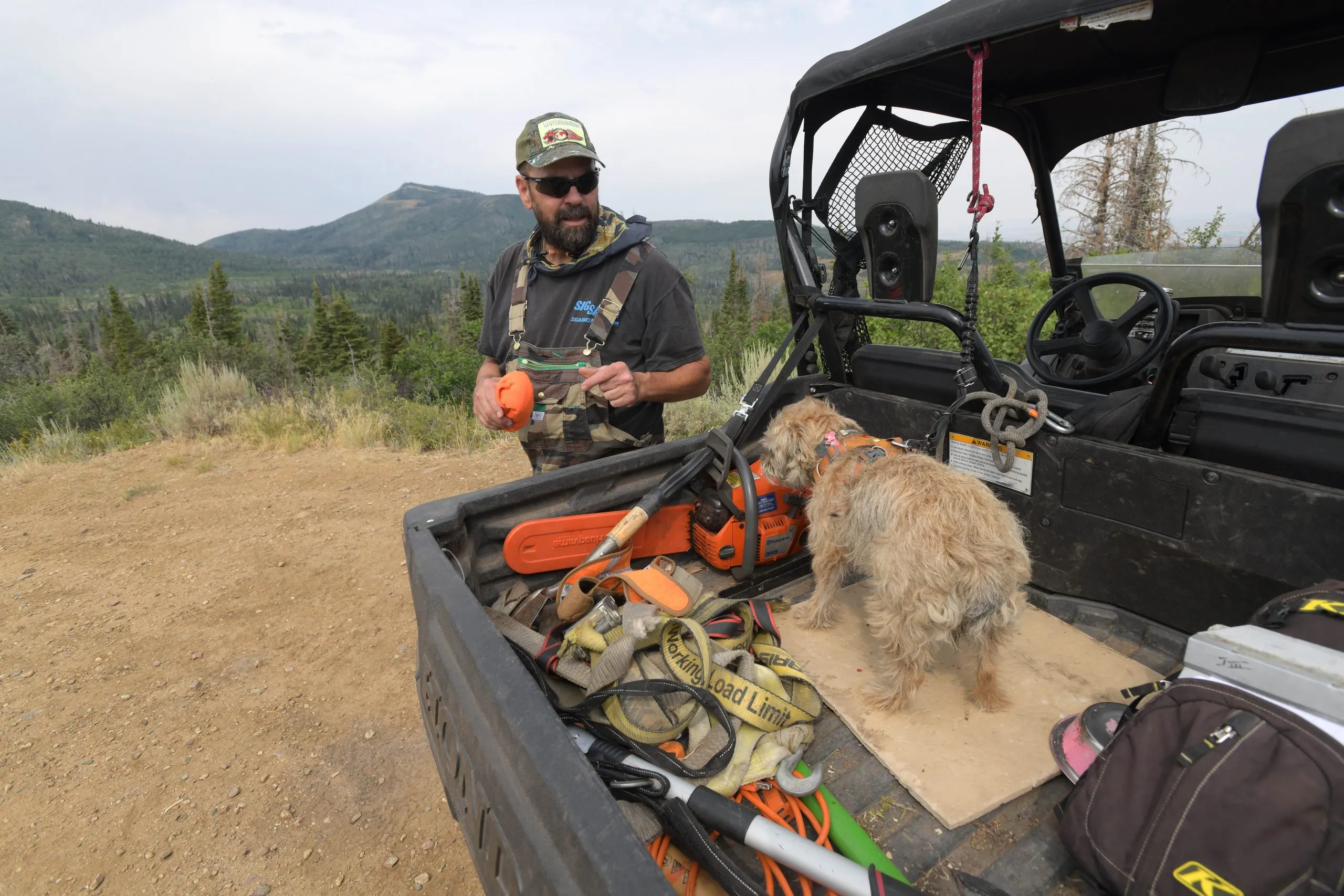
BAKER’S PEAK RANCH — From his bare-bones cabin on a little mountain thick with forests and laced with streams near the Wyoming border north of Craig, Joel Mayne is waging a one-man battle against the Trump administration’s push to sell oil and gas leases.
Mayne, a motorcycle instructor and Desert Storm veteran, organized landowners on the Moffat County promontory, , to protest the U.S. Bureau of Land Management sale of the mineral rights beneath the mountain.
When the BLM rejected the protests and the December 2025 sale went ahead, Mayne didn’t give up. Slaloming through a pack of bureaucratic gates, he has taken his fight to the Interior Board of Land Appeals in Washington, D.C.
While Mayne is carrying on a solitary struggle on Bakers Peak, he is not alone as environmental groups, state wildlife officials and local governments are protesting an unprecedented wave of public land oil and gas lease sales across Colorado.
Leasing for oil and gas drilling has been proposed from the Routt National Forest, near the Wyoming border, to near the Oklahoma state line in an area close to the Comanche National Grassland, including the iconic Roan Plateau near Grand Junction.
In all, from the December 2025 auction, including the Bakers Peak leases, to the planned December 2026 sale, BLM is slated to offer more than 400,000 acres of land in Colorado for oil and gas drilling across six auctions.
That is just about the same as the combined acreage of Rocky Mountain National Park and the Colorado side of the Dinosaur National Monument. Leasing is also being proposed near the Dinosaur National Monument in the northwestern corner of the state.
At the end of 2025, the BLM had 2 million acres of federal land in Colorado leased for drilling, with 73% of that acreage actively generating oil or gas, according to the agency.
Under the Trump administration, 287,765 acres have been offered in Colorado so far, with 215,128 acres sold, according to the Center for Western Priorities, which also counts 296 unused permits on federal land in the state.
The administration’s push to boost oil and gas production started on the first day of President Donald Trump’s second term with the executive order Unleashing American Energy, then came an order Declaring a National Energy Emergency, followed by H.R. 1, also known as the One Big Beautiful Bill Act.
The act requires Colorado and eight other oil producing states from Oklahoma to Alaska to hold quarterly oil and gas lease sales. Industry nominates the acres for auction, with at least 50% of the parcels offered in the first auction and all the acreage put up within 18 months.
This has led to record lease sales in Colorado — 155,000 acres in June and 124,766 acres this December.
The next auction is Tuesday for 29 parcels covering 14,095 acres, including 600 acres near the Aurora Reservoir in Arapahoe County, where residents have been fighting oil and gas drilling, and 3,438 acres in Weld County on or near the Pawnee National Grassland.
The big sales are a result of pent-up demand, as Colorado had just three lease sales between 2022 and 2025, said Aaron Johnson, a spokesperson for the Western Energy Alliance, a trade group.
“The Biden administration did not follow the law requiring quarterly leases,” Johnson said. The administration did hold quarterly auctions across the West, but not in every state.
“BLM Colorado resumed quarterly oil and gas lease sales in compliance with the Mineral Leasing Act, One Big Beautiful Bill Act, and relevant Resource Management Plans,” agency spokesperson Steven Hall said in an email.
“BLM CO is more efficiently processing lease nominations, which is a BLM priority,” Hall said.
Still, so many acres are being put up for sale that critics say oil and gas is overwhelming any other land use.
“We are seeing roadless areas leased, lands with wilderness characteristics, we are seeing places designated as outstanding waters leased, and it is hard to keep track,” said Peter Hart, legal director of the Wilderness Workshop, an advocacy group.
“We are seeing these offered in every lease sale.”
The split estate at work
In the scheme of things, Mayne’s skirmish with the BLM is a minor theater of war. The land on the peak is privately owned, but the minerals below are held by the BLM, in what is known as a split estate.
Mayne got his cabin — abandoned by its former owner — about 10 years ago. It was a shell and home to a variety of varmints. He worked to reclaim it and the surrounding land, but it is still pretty basic.
The cabin has a wood stove for heat, a propane cooktop and rechargeable electric lamps. Boxes of ammo are stacked here and there, with a copy of Henry David Thoreau’s “Walden” on the table and a book about Buddhism on a bookshelf.
For decoration, the passenger door of a Ferrari — a souvenir from an accident where Mayne was the passenger — hangs on the wall with the inscription “I shoulda let you drive.”
Driving around the peak in an all-terrain vehicle, Mayne pointed out the dense aspen forests on one side of the mountain that give way to stands of conifers, the natural springs and the broad meadows, which turn into wetlands.
“This is a little island before the land turns into desert,” he said.
In his November 2025 protest letter, Mayne said the peak is high-priority habitat for elk, mule deer and moose, as well as serving as home to a variety of other animals. The elk migration path runs across the mountain.
“This region’s ecological sensitivity and biological significance demand a level of caution and stewardship consistent with both federal and state conservation mandates,” Mayne wrote. “I trust the BLM will uphold its commitment to responsible stewardship of public lands.”
Fifteen issues were raised in protest letters. In its evaluation, the BLM said each protest issue “has been considered, found to be without merit, and is denied.”
The lease sale went ahead and the minerals under Mayne’s land and that of his neighbors were purchased by Carmony Exploration LLP, which has a Lafayette residence as its address.
In all, Carmony Exploration purchased 13 parcels totaling 16,588 acres paying $1.9 million in per-acre fees, first-year rent and administration charges, according to BLM records. The company was active in the area in 2013, Routt County records show.
“Given the recent attention to our general project area and the high level of industry interest shown at recent BLM lease sales, we are being careful about when and how we release information to the public,” John Carmony said in an email.
Undeterred, Mayne took his challenge to the Interior Board of Land Appeals, an independent appellate review body within the Department of the Interior. The instructions for filing an appeal ran three pages and required filing six documents.
“It is a crazy process and it ran into hundreds of dollars in registered mail,” he said.
Mayne has one last step, filing a statement of reasons. “I was rushing to meet deadlines, but I am going to take some time to write this,” he said.
To the north of Bakers Peak sits the flat plains of Wyoming and to the south looms the 10,500-foot summit of Bears Ears Peak in the Routt National Forest.
The national forest is another emerging field of conflict. For not only are BLM lands in play but so are minerals on the national forests.
An “expression of interest” in 10 parcels covering 13,850 acres was filed with the National Forest Service by the BLM, for “potential future oil and gas lease sale and subsequent exploration.”
The proposal immediately galvanized environmental groups and local officials.
“This is a beautiful and sensitive area. It is home to the second-largest elk herd in Colorado, the E2 Bears Ears elk herd,” said Larry Desjardin, president of Keep Routt Wild, a local environmental group. “Most of these parcels are actually an elk birthing area.”
In June the Forest Service issued a draft Environmental Assessment evaluating potential impacts on 25 resources — including air quality, fish habitat, forests, wetlands, recreation and threatened and endangered species.
The assessment concluded they were “unlikely to be affected” by offering the land for leasing, with the caveat that further evaluation and protections — called stipulations — could be added when there is an actual leasing proposal.
“We think they are getting way out in front of their skis because we don’t have the proposal about how these things are going to be drilled, where you would put roads, none of that,” Desjardin said.
The Routt County commissioners also disagreed with the Forest Service conclusions.
“Routt County reiterates our position that oil and gas development on public lands is not the highest and best use of these lands,” the commissioners wrote in a July letter to the Forest Service.
“Even without considering impacts on wildlife and recreation, prior oil and gas development efforts in Routt County have not proven to be economically viable,” the letter added.
The commission also pointed out that the protections or stipulations available for leases would be based on the management plan for the forest, which was done in 1993 and last updated in 1998.
“Routt County fundamentally disagrees with the premise of Executive Order 14156,” which declared a national energy emergency, the letter said, “… and (we) do not appreciate the continued pressure from the current administration.”
Commissioner Sonja Macys said “there is a conflict between what the administration wants to do and where Routt County sees its future, with the natural environment and recreation key to the county’s economy.”
“The Bears Ears trail, which is really popular for hiking and biking, cuts right through the area being proposed for drilling,” she said.
Colorado Parks and Wildlife also sent a letter to the Forest Service requesting that eight of the 10 parcels be removed from leasing as they are state high-priority habitats having “an extraordinary combination of wildlife habitat value for elk, mule deer, greater sage-grouse, Columbian sharp-tailed grouse, and fishery resources.”
Many of the parcels are also part of the 2012 Colorado Roadless Rule, which prohibits construction in those areas. (The Trump administration is moving to repeal the 2001 federal roadless rule, though has said it will honor existing state roadless rules, including Colorado’s.)
The Forest Service said in a statement that it is reviewing the public comments on the draft assessment and the CPW letter before publishing a final assessment, which may include stipulations if applicable.
The final environmental assessment will also be open to public comment and any future exploration and development would need site-specific environmental reviews, the Forest Service said.
In 2024, the BLM adopted a big-game resource management plan amendment to align federal management of leasing with wildlife regulations of the Colorado Energy and Carbon Management Commission.
Still, the BLM’s Hall said “state rules can be considered by the BLM in the BLM’s decision-making process, but state rules do not replace federal decision-making or federal laws or rules.”
In the June sale, the BLM put up parcels on the Tuttle Ranch, in Moffat County, even though the state had spent $4.2 million in conservation easements to protect high-priority habitat for greater sage grouse.
In all, an estimated 77,000 acres of greater sage grouse habitat has been proposed for oil and gas development, according to the Center for Western Priorities.
The real catalyst for this wave of oil and gas leasing across the West was H.R. 1.
Terms of BLM leases were changed to make sales more attractive
During the Biden administration, a series of changes were made to the leasing program, in some cases the first changes in a century.
These include increasing minimum cleanup bonds to $150,000 from $10,000; raising the royalty rate to 16.67% from 12.5%; and increasing the minimum bid for a parcel to $10 an acre from $2.
If a company wanted to nominate a parcel, it had to pay a $5-per-acre expression of interest fee. This was to cut down speculation on oil and gas properties. The annual rental rates on leases were increased, rising from $3 an acre in the first two years to $15 an acre for the last two years.
Preference criteria were set up to screen lease parcels to better protect wildlife recreation and cultural resources. The law did away with noncompetitive leasing, where parcels not sold at auction could be leased for as little as $1.50 an acre.
Most of the changes were in the Inflation Reduction Act, President Joe Biden’s signature legislation. They were swept away by Trump’s H.R. 1 and a series of changes underway in the rules governing auctions and sales.
H.R. 1 mandated that Colorado, Wyoming, Utah, New Mexico, Idaho, Montana, North Dakota, Alaska and Oklahoma each had to hold quarterly sales. And if more than 25% of the parcels weren’t sold, BLM under the act had to have a second “replacement sale.”
In the December 2025 Colorado auction, more than 30% of the parcels were not sold. BLM held a replacement sale in January for 20,000 acres. There were no bidders.
For individual leases, the royalty rate was returned to 12.5% and noncompetitive leasing was restored.
“By lowering the federal onshore royalty rate from 16.67% to 12.5%, the One Big Beautiful Bill Act reduces the cost of doing business on public lands, making oil and gas development more economically attractive to industry,” BLM said in a statement.
“This is expected to spur additional leasing and drilling activity, which in turn supports increased domestic energy production and strengthens U.S. energy security,” the agency said.
The royalties on oil and gas produced on federal land are split about 50-50 between the federal government and the producing states. In 2025, Colorado received about $91 million in royalties, which were distributed to communities.
“That’s money that goes to schools and libraries, to local police, firefighter services,” said Johnson, the spokesperson for the Western Energy Alliance.
“Mesa County is on the front lines of wildfires,” he said. “Here we are in wildfire season, those local fire departments are getting needed money, and that’s happening through oil and gas revenues.”
Mesa County received $660,000 in royalty money in 2025 and the local school district got $88,000. Nearby Rio Blanco County — the scene of serious wildfires in 2025 — was the recipient of $1.3 million in royalties and its school district was awarded $134,000.
Even Denver got a royalty payment of $70,000, while the city of Boulder received $6,900.
And oil and gas development has shown itself to be compatible with agriculture and even recreation, Johnson said.
The Palisade Plunge, a popular 32-mile mountain bike trail above the town of Palisade, cuts through BLM land with oil and gas development. “So, you’ve got mountain bikers that are going by oil and gas wells, and likely they don’t even know they are there,” Johnson said.
Still, most of the royalty money Colorado received was at the 12.5% royalty rate. That compares with an 18% to 20% royalty rate the Colorado State Land Board assesses when it issues oil and gas leases on state land.
A study by Taxpayers for Commission Sense calculated that if federal leases in Colorado had carried an 18.75% rate instead of the 12.5% and 16.67% royalty, Colorado would have received an additional $468 million between 2015 and 2024.
Bolstering H.R. 1, the BLM in June proposed new rules for oil and gas leasing aimed at “eliminating unnecessary administrative barriers.”
Among the changes would be limiting the time for public comment on lease sales to 10 days from the current 90 days, returning the bond for an individual lease to $10,000, and cutting the lease application fee paid by companies for each parcel to $155 from $3,100.
BLM describes the change as “modernizing filing fees.”
At the same time, if a person or group files a protest of more than 50 pages, under the proposed rules, they would have to pay $1 for each additional page.
Since environmental groups often include scientific studies and data with their protests, this rule will run into thousands of dollars for each filing, Juli Slivka, senior policy director for the Wilderness Workshop, said.
Another change would eliminate the notification to surface owners, like Mayne, who own land, but not the minerals below. So even if the minerals underneath their land were leased, the property owners may never know.
“The BLM proposes to remove this requirement as a regulation that imposes undue burdens on the oil and gas industry,” according to the proposed regulation.
“There is this huge rush to get public lands into private hands,” Slivka said.
Who’s buying the leases? It’s hard to tell.
And into whose hands are those leases going?
A review of nominations and sales compiled by the environmental group Rocky Mountain Wild shows that among the most active nominators and buyers are companies specializing in land acquisition and apparent shell companies.
Of the 704 Colorado parcels nominated for 2026 auctions, Ajax Minerals LLC designated 44% of them. Echelon Land and Minerals nominated another 65 parcels. The parcels primarily are in Moffat and Rio Blanco counties.
Both companies registered with the Colorado Secretary of State on Dec. 5, 2024, and gave their address as the downtown Denver office of the law firm Senn Fortis, which did not respond to email and phone requests for comment.
Local land companies specializing in the buying and selling of oil properties, including Zenith Land Company and Context Energy Company, are also active. Neither company responded to telephone and email requests for comment.
One of the most active bidders in the March and June auctions was Corpus Christi, Texas-based R&R Royalty Ltd., which has interests in about 400 wells, with the company operating some 150 of those, according to its website. Most of the wells are in South Texas.
In the two Colorado auctions this year, R&R Royalty successfully bid on 39 parcels, mainly in Rio Blanco and Moffat counties, for a total of about $950,000, according to BLM records.
Avinash Ahuja, R&R Royalty’s CEO, noting that it is “a highly competitive business,” declined to get into specifics but said in an email “we are optimistic about the future potential of these areas where we purchased leases.”
Efforts to get a handle on who is nominating and bidding on parcels has been a challenge, said Kim Stevens, the climate policy director at The Wilderness Society, a national environmental organization.
“It’s not simply a story about oil and gas production,” she said. “It is a story about the future of public land and whether it will continue to be managed for multiple uses and multiple generations, or managed to serve a single industry.”
Fighting over the Roan Plateau
When it comes to Colorado fights over oil and gas leasing on federal lands, there was no greater battleground than the Western Slope’s Roan Plateau, and in the current round of leasing no greater symbol of the conflicting forces at work.
From the air, the federal land on the northeastern side of Roan Plateau stretches like a rippling, green rug of sagebrush, sage, aspen and evergreen, dotted with meadows and woven with silver steams and an occasional brown thread of a trail.
There are more than 20,000 acres identified by the BLM as wilderness-quality lands, which are home to black bears, mountain lions and sage grouse. Mule deer and elk migrate to the nearly 9,000-foot plateau in the summer.
The Roan waterways, like Trapper Creek and Northwater Creek, have been designated Outstanding Waters by the state and are home to a genetically pure population of Colorado River cutthroat trout.
But deep beneath the streams and forests lies the Green River Formation, a shale stratum potentially rich in oil and gas.
So, when turning to the southern end of the plateau, where more land is in private hands, the forest is cut by roads and a patchwork of well pads and storage tank farms.
The federal land on the Roan, unlike many of the other parcels now up for lease, has already been leased, and was the subject of a court battle and a compromise agreement to keep drilling off the plateau.
BLM first proposed issuing oil and gas leases in 2007 as part of a push by the administration of President George W. Bush to open land to drilling. It sparked protests by community and environmental groups and a lawsuit.
Still, the agency went ahead with the auction in August 2008 leasing 55,186 acres atop and alongside the Garfield County mesa. The sale raised $114 million, which the bureau said was at the time the most revenue raised in a sale in the Lower 48 states.
In 2012, a Denver district judge ruled that BLM had not followed its protocol in issuing the leasing plan, and two years later the environmental plaintiffs and the bureau reached a settlement.
All but two of the leases atop the plateau were canceled and Denver-based Bill Barrett Corp. was reimbursed $47.6 million. The Biden administration in 2024 issued a more protective plan for federal lands on the Western Slope, including the Roan Plateau.
But under H.R. 1, nominated parcels go to auction and nine parcels totaling 4,645 acres have been nominated by three companies. The BLM also nominated one parcel.
Two parcels were nominated by Denver-based Laramie Energy and established operator in the Western Slope’s Piceance Basin. Elevation Resources, a Denver-based oil and gas brokerage firm, designated five parcels. Neither company replied to email and phone requests for comment.
The last parcel was nominated by DP HITB 6-25 LLC, which incorporated in Colorado in June 2025. The company has no website, email or phone number and its address is a house in Denver’s RiNo neighborhood.
“People largely looked at the Roan Plateau as a settled matter,” said Jim Ramey, the Wilderness Society’s Colorado state director.
“The Roan is one of those special places that really needs to be set aside,” Ramey said. “This is a moment for a rallying cry around this place. And what went into that settlement agreement years ago, I think at its most basic level, was a desire to see the federal public lands up there left alone.”
Read more Manny Rutinel resigns from Colorado legislature to focus on pivotal congressional race