 By admin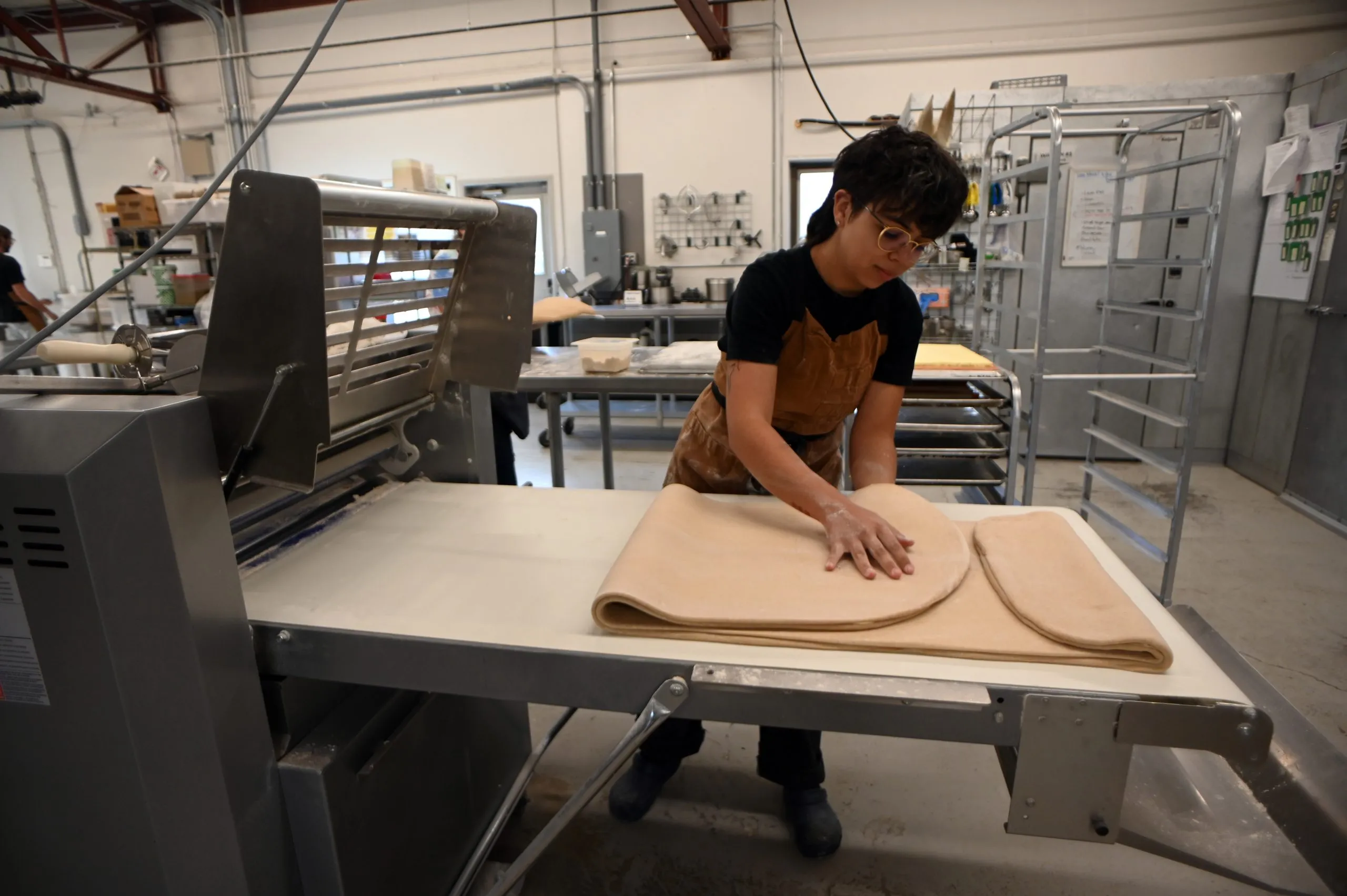
As Denver Bake Fest returns Saturday for its third year celebrating the craft and community of local baked goods, many of the state’s commercial bakers have found themselves enmeshed in the even broader agricultural community.
These bakers and grain millers are finding strong and increased demand for a more bespoke, traceable experience that breaks away from a commodity agricultural system that treats grain as a generic, interchangeable ingredient.
Before making the pivot to flours milled in Colorado from locally grown grains, Bake Fest founder Zach Martinucci used standard commodity flours in his startup Rebel Bread in Denver.
“That’s what I had learned on in baking school and hadn’t really been introduced to regional grains or heritage grains,” he said. A number of his team members were interested in local grains and sustainable agriculture, and were hearing about what local farms and mills were doing. After going to the Maine Grain Alliance conference in 2022 and seeing how that region’s producers had gotten involved in heritage grains and a local grain ecosystem, Martinucci got on board.
“It was really inspiring to see the connections that bakers, brewers, distillers have with with their source of flour or grain and the effect that it had on the product being so much better and tastier as well as more nutritious, at least for bread, seeing how it supports local economies and sustainable agriculture,” he said. “Coming back from that, it seemed like the thing we should be doing as a bakery.”
Rebel Bread began partnering with Dry Storage mill in Boulder, leaning into the improved flavor of their fresh, heirloom flour rather than pushing the storytelling aspect of local flour. Martinucci didn’t increase prices, even though the new flour was more expensive. The business was growing enough to realize new efficiencies, so he chose to spend those savings on the raw ingredients.
“We didn’t want people to feel like they had to pay more for something that we just thought was the better option and wanted to make our standard,” he said.
Martinucci was able to expand Rebel Bread’s footprint in late 2025, nearly tripling its space in the Denver Design District to include a full-service cafe, dedicated teaching kitchen for their baking classes and expanded production space. The bakery focuses on artisanal bread and pastries, including wholesale production for coffee shops, restaurants and even a few breweries and distilleries.
“Our priority, at least moving forward, is that anything new we develop is featuring as many single-varietal Colorado grains as we can,” he said.
The success of Rebel Bread and other local grain users has allowed Dry Storage in Boulder, in turn, to grow and expand. Originally founded in 2019 as part of chef Kelly Whitaker’s restaurant Basta to showcase local grains, Dry Storage moved into its own dedicated space in 2021 and spun off from Whitaker’s Id Est hospitality group in 2023 as they saw that it could grow to supply other enterprises beyond the restaurant group. (The original location, what the team refers to as the Dry Storage bakehouse, remained with Id Est and is legally distinct, though the two operations still work closely together.)
“Everything is chef-led. Our partners at Id Est, they just got the first two Michelin Star restaurant in Colorado,” Emily Philpott, CEO and board chair at Dry Storage, said, referring to Whitaker’s Denver restaurant The Wolf’s Tailor. “That allows us to use their huge speaker and the huge spotlight on their platform to really amplify what we’re doing with the grains.”
Dry Storage has largely focused on business-to-business sales. Selling to bakeries, restaurants and other large partnerships allows them to dedicate their energies to the avenues where they can make the most impact by moving the most flour.
“We’re seeing people really understand what we’re trying to do from a mission standpoint, but also just how much better the flavor and performance is, so we’re seeing seeing an uptick in sales,” Philpott said, adding that they’re expanding focus on their e-commerce platform and shipping through Amazon to see if they can establish a presence in the general consumer’s pantry. “It’s a smaller volume, but it’s a huge purchasing power that can really help us push the movement forward.”
With that momentum, Dry Storage went into fall 2025 with a goal of doubling the acreage they contracted with farmers to grow specific varieties of wheat, Philpott said. The historically low snowpack and dry conditions that followed made growing wheat much more difficult in 2026, but they had diversified their farmer relationships to include farms in Wyoming and Montana.
“As much as this drought personally hurts, it’s exciting for us in the sense of expanding our network,” she said.
Along with a doubling of their grain-growing acreage, they’re also planning a doubling of capacity at the mill itself, with a new stone mill and additional equipment scheduled to be installed in January, funded in part by a Smart Climate Solutions grant from the Colorado Department of Agriculture to support the company’s efforts supporting regenerative farming practices.
Milling in a cafe basement
While Front Range bakeries like Rebel Bread team up with local partners for flour, Chris Sullivan decided to bring more of his supply chain in-house at Mountain Oven Organic Bakery & Millhouse in Paonia. He first opened in 2010 in Crested Butte, renting space at a local cafe and lugging a small stone mill into the basement to start selling at the local farmers market.
He gradually expanded into wholesale operations while running a retail bakery and cafe. Sullivan moved the whole Mountain Oven operation to Paonia in 2018 and dropped retail sales to focus on building the bakery’s wholesale business and serving a couple of regional farmers markets.
“That helped reduce the breadth of what we were doing and really allow us to go deeper into the core craft of what our operation is about, which is baking and milling,” he said. “My background is in small agriculture, and so I feel pretty at home on small farms and had quite a number of friendships with farmers in this valley. My partner Dana (Whitcomb) and I were pretty eager to land somewhere that was more of an agricultural community that we could really be within our community of growers.”
Milling moved more toward center stage. Sullivan had been doing what many artisan-scale miller/bakers do: mill their own whole-grain flour and buy white flour from a larger operation to use as the foundation for many of their products. But he decided that moving over to 100% freshly ground flour for his range of breads and pastries was worth the investment.
Read more Amendment 82: Colorado voters will decide whether to put right natural gas in state constitution
“Fresh-milled flour definitely has a lot better flavor,” he said. “Even sitting in a bag for a period of time, there’s quite a bit of air mixed in with the flour that changes it at the chemical level.”
LEFT: Mountain Oven founder Chris Sullivan takes a sample of wheat to check moisture content as it comes into the mill in Paonia. RIGHT: Sullivan examines the portion of bran being sifted out of a batch of flour to ensure that the mill is running properly. (Gabe Toth, Special to The Colorado Sun)
To accomplish the transition to milling all their own flour, they had to invest in multiple upgrades, including a larger mill that he hopes will be the foundation of a revamped and relaunched retail and wholesale milling operation that can get their flour further out into the market. For the time being, though, the bakery supports the milling operation.
He also has made it a priority to install cleaning and lots of storage capacity, both of which are often barriers to entry for farmers who want to work more locally. He said they source multiple varieties of wheat and rye, as well as smaller amounts of corn, oats, barley and whatever other grains he can get his hands on. Mountain Oven is more focused on supporting local farmers economically than buying grain that falls under a specific label like “organic” or “heirloom.”
“As a baker, it’s really fun to have a diversity of grains to play with,” he said. “We try to use what our local producers are growing. We use a combination of heritage grains and modern wheats. I definitely think there’s a place for all of that in the world of baking and farming.”
Finding a mix of flours that is just right
Hannah Rossman founded Blue Grouse Bread in Norwood in 2016 with house-milled whole-wheat flour and a presence at local farmers markets in places including Telluride and Ridgway. Rossman has a lot of respect for the bakeries using 100% whole grain flour, nodding to Tumbleweed Bread in Monte Vista and Pueblo Food and Seed Co. in Cortez, but that’s not the model that they follow at Blue Grouse.
She does use white flour, sourced from Central Milling in Utah, noting that a large portion of the wheat for that flour likely comes from the Dove Creek area southwest of her. Rossman works to offer a range of breads, starting with “gateway” loaves that rely on white flour, which lends something special to crisp, airy baguettes, for example.
“We’re trying to be the gateway for people, to get them into the whole grain,” she said. “There is some magic that comes from white flour, even though it doesn’t have the nutritional components of whole wheat that we wish it had. I think our entire country is used to a more processed product, unless someone’s seeking that out. You’ve got to give them something of a choice.”
She’s worked over the years to steadily increase the percentage of whole grain in Blue Grouse’s country loaf, which is a blend of white and whole wheat flours. Rossman also makes sure to offer a 100% whole grain option.
“Darker, denser bread is a harder sell, so part of our business model is to offer a range,” she said. “But my goal from the beginning is: Let’s just make as much whole grain as we can put into this bread, and push it until we feel like we’ve pushed that boundary as much as we can.”
Blue Grouse eventually moved from farmers markets to a wholesale-only operation, bringing in a bigger mill, a bigger mixer and building a mill shed, while capping production at a sustainable level. The bakery serves a diverse footprint both geographically and economically, supplying locations from Montrose and Ridgway to Norwood and Telluride and outlets from local small-town grocers to high-end restaurants.
“I’ve been surprised at how consistent and predictable our bread sales are,” she said. “I do think people care about local foods, even in these tough economic times where groceries are really expensive. We see people still choosing our products when there are more affordable options.”
Since she’s focusing on the wholesale channel, Rossman said she’s not communicating as directly with customers as she was when she sold loaves at the farmers market.
“I wouldn’t be surprised if a lot of people don’t even know that we mill our own whole wheat or that they’re eating local grains,” Rossman said. “I really think most of our customers are just buying the bread because it’s pretty good bread, which is great.”
She said there’s “definitely some momentum in the local grain movement,” a key piece of developing a local food system which she watched first in Vermont, where she grew up, and now in Colorado.
“Grains are almost always the last thing to come into the picture, which is also funny because we’re an amazing grain-growing state,” she said.
Sullivan agreed that, while the local grain supply chain may lag behind other local foods, the momentum is building as local infrastructure becomes increasingly available, farmers increasingly look for local outlets, and chefs and consumers start to recognize the difference.
“I think that, in the farm-to-table movement, grain is the caboose pulling up the rear. It takes a hell of a lot less investment to grow salad greens for your local chef than it does to grow grain for your local baker,” he said. “But there are more regional mills coming online around the country and people are starting to have more of an awareness that that’s an option, and once you bake with the fresh flour, it’s like eating a tomato off of the vine versus a winter grocery store tomato. You can immediately taste the flavor difference, and it’s more meaningful at the end of the day.”