 By admin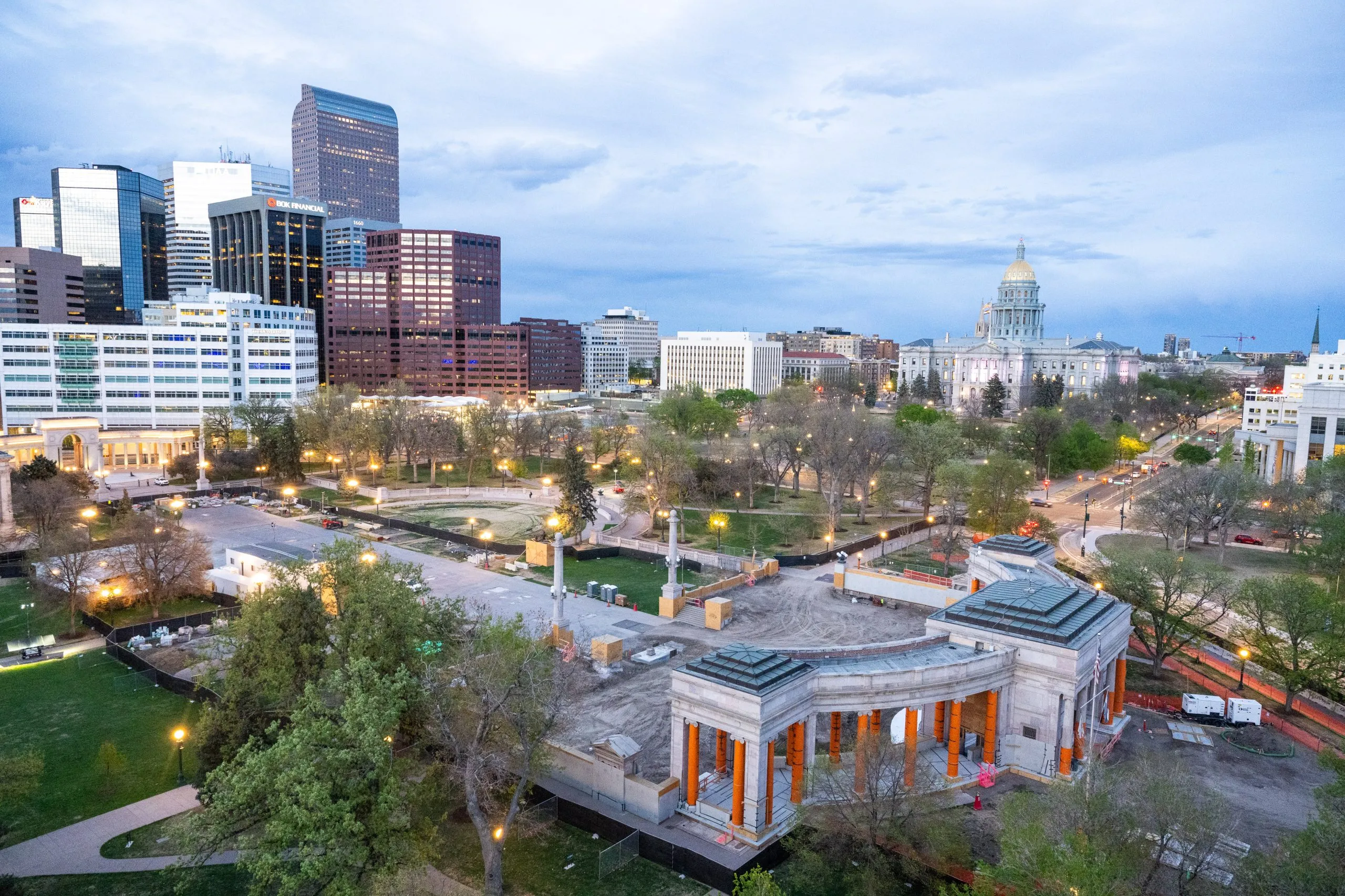
It’s the people’s park, the heart of downtown Denver.
Civic Center park, seen from the Denver Art Museum on April 16. (Andy Colwell, Special to The Colorado Sun)
In its 100-year history, Civic Center has drawn Coloradans as a hub of culture and learning …
This glasss negative photograph from some time in the 1920s shows a crowd watching the Denver Municipal Band at Civic Center park. (Denver Public Library Special Collections, X-29804)
… and also repelled them because of crime and filth.
Attendees light up during the 2018 Mile High 420 Festival in Civic Center park. (AP Photo/David Zalubowski)
A $50 million transformation of the 12-acre park is underway, including shady outdoor “garden rooms,” winding pathways and a renovated, Greek-style theater wired for concerts and performances.
A rendering of the reimagined Greek Theater at Civic Center park. (via Civic Center Next 100)
This ambitious reimagining is happening alongside a $12.5 million revival of the historic McNichols Building at the edge of the park, featuring a restaurant serving dinner on the lawn, a patio where people can sip lunchtime coffee, and to-go sandwiches for picnics in the park.
Denver’s McNichols Building on June 5. (Andy Colwell, Special to The Colorado Sun)
The refreshed public space that spans the Denver City and County Building and the state Capitol is expected to reopen in the fall of 2027.
The Greek Amphitheater , under construction on June 12. (Andy Colwell, Special to The Colorado Sun)
But a successful revitalization of the park — a key to the mayor’s “vibrant” downtown — will require not just a physical makeover, but a significant turnabout in public perception.
A photo from the 1920s by George L. Beam shows men on chairs between the columns of the arched colonnade at Civic Center park.
(Denver Public Library Special Collections, GB-5034)
The park renovation is funded with $30 million from the Downtown Denver Development Authority, a voter-approved initiative to invest a portion of sales and property taxes collected downtown into revitalization projects. Additional funds come from the voter-approved Elevate Denver bond, the Denver Parks & Recreation budget and donations. The Civic Center Conservancy is attempting to raise $10 million for the project.
Reviving the park is central to the city’s broader strategy to make downtown a destination again, to lure people from the fringe and sprawl neighborhoods where they have their own parks, outdoor markets and festivals. It is the core of a plan to bring back the workers and the apartment dwellers, and the suburbanites going out to dinner.
The big flip
For now, the historic columns of the Greek-style theater, on the south side of the park and across the street from the Denver Public Library, are covered for protection as construction crews dig out a new theater bowl. A bronze statue of a Native American man on horseback with a spear in his hand is surrounded by plywood stamped with “historic art.”
The site is currently a giant hole in the ground, where workers are pouring concrete to create new seating to face a new stage, covered by a canopy. It’s a design from renowned Chicago architect Architect Jeanne Gang. The original stage and columns will serve as a scenic backdrop, behind the audience, as well as provide shade. And the new seating, unlike the old, will be accessible to people with disabilities and will face the opposite direction, into the park.
“It was a very hot place, and you looked directly into the sun,” said Gordon Robertson, director of Planning Design and Construction at Denver Parks & Recreation. “We called it the brick oven.”
And unlike the past, when performers had to bring their own audio equipment, the new stage will have “all of that in place and ready to plug in,” he said.
“Our goal is to have this be the stage for the whole community of Denver, where any small group can come in and put on a performance any day of the week. To invite everyone in and to have performances there as much as we possibly can … theater, dance performances, music. You could do TED Talks, yoga.”
LEFT: Night view of a Colorado Symphony Orchestra concert at the Greek Theater and Colonnade of Civic Benefactors in Civic Center park in 1938. (Denver Public Library Special Collections, Z-10010) RIGHT: A rendering of the reimagined Greek Theater with the stage on the opposite end of the historic bandstand. (via Civic Center Next 100)
The from hosting only three or four large community events per year, to a hub of daily activity, Robertson said. The timing is perfect, he insists, in part because of the growth of the Golden Triangle, the neighborhood south of West Colfax Avenue bounded by Speer Boulevard and Broadway, which is the fastest-growing downtown neighborhood, adding about 7,000 residential units in the past decade.
“The park has never looked more beautiful or been more safe,” Roberson said. “The folks that enjoy it today understand that. Unfortunately, it’s one of Denver’s best-kept secrets that Civic Center is beautiful, safe and clean.”
Civic Center’s regulars
A surprise burst of rain on an April afternoon left the lush grass at the park sparkling in the sunshine. Flower beds were bursting with pink and purple blooms, and the winding pathways were washed clean. The park was empty, minus the construction crews working on the Greek theater and a man named Gary who sat on a bench drinking a beer with his next beer sitting unopened beside him.
“Read any good books lately, Gary?” asked Jodie Marozas, park ranger manager for Denver Parks & Recreation, who has led the park’s cleanup.
Gary, a park regular, was homeless until getting an apartment about two years ago through the city’s All In Mile High housing initiative, which the mayor’s office says sheltered 2,500 people and closed 350 city blocks to camping. Alcohol is allowed in the park, as long as it’s not in glass.
“Gary is welcome here,” said Eliza Hunholz, the city’s director of the park ranger program. “Bad behaviors are not.”
Read more Colorado man dies while hiking 14,000-foot mountain near Ouray
The pandemic
To fully comprehend the magnitude of Civic Center’s glow-up, consider what it looked like in 2021.
That September, citing rampant crime, rat infestation, and human feces and used drug needles littering the ground, the city shut down Civic Center and put up a fence. The park had been the site of drug deals and other illicit activity for years, but it had gotten worse during the pandemic when Lincoln Veterans Memorial Park, the strip of land across the street in front of the Capitol, became a tent city littered with chicken bones and plastic bottles of urine.
Civic Center was closed for six months. Park rangers and Denver Police patrolled it day and night, enforcing an overnight camping ban and offering assistance with housing and substance use treatment.
The long-time tradition of “mutual-aid Mondays,” where church groups and nonprofit organizations handed out lunches and clean socks to the homeless, was shooed out of the park. The services were moved to locations “where they could ensure food safety” with hand-washing stations and ovens to keep the food hot.
The clean-up
It was Marozas’ job to clean up the park.
When it reopened, the city “took back over the park,” she said. “We were constantly cleaning. We had concerts here, just tons of positive activation, including the food trucks and everything to draw people in to show them that this was a safe space.”
Yoga classes. Pickup soccer games. Maintenance crews powerwashing sidewalk stains, repairing flower beds. And rangers in uniform ready to “target unsafe behavior.”
“I was in awe of the huge change,” Marozas said.
The key to the change was that park rangers, whose actions historically had been “complaint-driven” — about everything including off-leash dogs — shifted to proactive mode, with a major focus on the park.
“It’s going to be the spot where everybody wants to be,” Marozas said, “and I’m really excited for all of the improvements and what the future is going to look like.”
The people who live here
The park’s new look is obvious to people paying attention.
Grady Ward, walking his Bernese mountain dog along the sidewalk on West 14th Avenue Parkway next to the park, has “definitely noticed” how clean and empty Civic Center has been lately. He wonders, though, if the city can pull off the right balance between creating a “third space” that families can enjoy and one where everyone, even those who are homeless, are welcome.
“I care about third spaces for everybody, and I think that people tend to be comfortable with third spaces until people who are unhoused show up. I would prefer we have public spaces in which, yes, there are not unsafe things happening, but also there are not exclusionary dynamics.”
— Grady Ward, who has attended events at Civic Center park
“Denver does not suffer from a low volume of places to sit and drink a glass of wine or beer, and so I don’t know how much an additional place to do that is gonna be needed, but I am glad they’re investing in the public space,” Ward said. “I care about third spaces for everybody, and I think that people tend to be comfortable with third spaces until people who are unhoused show up. I would prefer we have public spaces in which, yes, there are not unsafe things happening, but also there are not exclusionary dynamics.”
David Gordon was homeless before landing a spot at the Forum Apartments, a Colorado Coalition for the Homeless supportive housing complex across the street from the park. As he sold copies of the Denver VOICE newspaper on a spring day, Gordon said he was tired of people who are homeless getting treated like unwanted guests.
“Unhoused people get blamed for things that are out of their control — the park being that messy, the needles, the feces,” he said. “I just think we should question ourselves: Are we being discriminatory towards people who are unhoused? I mean, I don’t mean to be sarcastic, some of the people should be thanking the homeless. Because of the homeless, and the perception of fear, these security guards have jobs. You should extend your hand and thank them for being here.”
When the park reopens, there will be public restrooms on the exterior of the McNichols Building.
What to do with McNichols?
LEFT: A glass photoplate by Louis Charles McClure taken between 1924-1927 shows the McNichols Civic Center, then in its original incarnation as the city’s Main Library. RIGHT: Denver’s McNichols Building is pictured on June 5 in Denver. (Andy Colwell, Special to The Colorado Sun)
At the northwestern edge of the park, where Colfax Avenue bends to curve around a historic fountain framed by marble columns, stands the McNichols Civic Center. The city-owned, Greek Revival-style building opened in 1910 as a Carnegie Library, and for its first 45 years, served as a center of learning.
It was closed for about four decades, before reopening as a cultural center that was used for occasional performances, exhibits and parties — and sometimes, a temporary shelter for the homeless during freezing temperatures. In 2024, Denver covered some of the massive, 33,000-square-foot building with mats and housed migrants from Venezuela, who were arriving so frequently and in such high numbers that other shelters were full.
Now imagine something completely different. Picture postpandemic “vibrant Denver,” as Mayor Mike Johnston calls his plan to upgrade downtown.
Cultural events at McNichols did not recover well after COVID — the building was rarely rented as an event venue as fewer workers reported to downtown offices and homelessness was more visible than ever on city sidewalks.
“Now there is a really big push, obviously, to activate downtown,” said Jen Morris, chief of staff for Denver Arts and Venues, a city agency. “We just realized what an opportunity we have when our mayor is really focused on vibrant Denver. We wanted to make sure that this building was used not just for evening events or a daytime event here and there, but it had seven-day-a-week activation.”
Enter the plan for the first-ever restaurant “embedded” in a Denver public park. Think New York City’s Tavern on the Green in Central Park, but the casual Denver version. “This should be for the people,” Morris said. “This should have things that you know are for all ages and for all price points, and maybe a little nicer at night if you want a nice dining experience.”
With funding from Denver Arts & Venues, and $7 million from the Downtown Denver Development Authority, the renovation will include a first-floor restaurant and outdoor patio and courtyard, a second-floor museum and a third-floor special events space. The reimagined building will also have a ground-floor marketplace near the restaurant highlighting work from local artists.
The vision is couples sharing lunch on a patio overlooking the park, families picnicking in the grass after buying grab-and-go sandwiches, office workers stopping by for coffee and bagels. And on warm nights, a lively patio that is creatively enclosed in order to comply with the restaurant’s liquor license. “What a beautiful way to spend an evening,” Morris said.
Construction is under way, and the city has selected the restaurant and museum operators who will create the space, though city officials won’t release their names until contracts are finalized. The museum will focus on Denver history and culture. The restaurant will get a deal on the lease — the city is offering a below-market incentive to create “community amenity,” Morris said.
She’s confident that people will come to the park, even if they have to see the change to believe it. “Once the word gets out,” Morris said, “I think people will realize that it really is a destination, not just a walk-through or pass-through.”
Read more How three Denver artists are spending $50,000 to fund their passions