 By admin
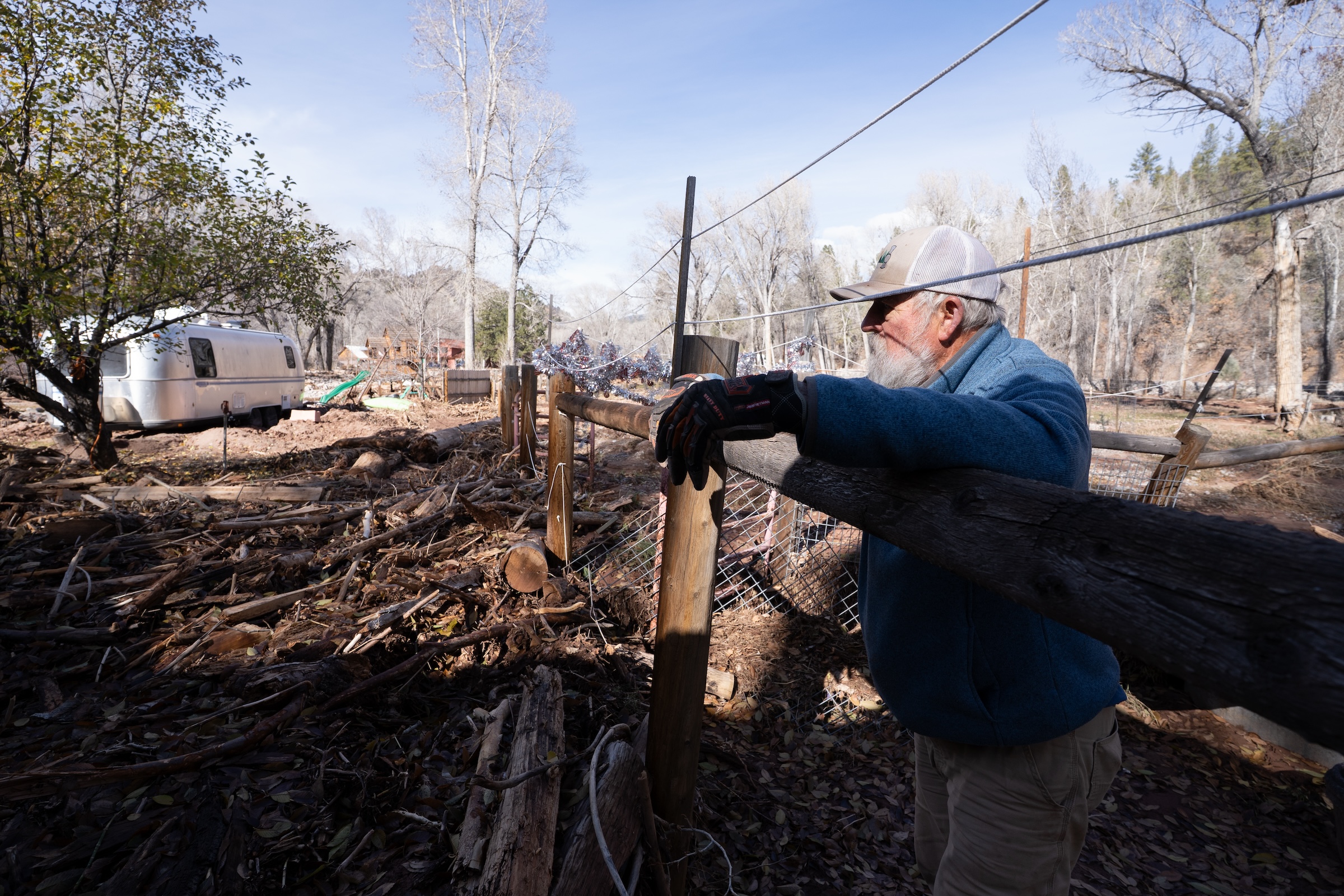
The flooding in southern Colorado turned Pete and Candace Harter’s world upside down.
Read more Colorado PERA board approves new limits on investment staff bonuses
Their house in La Plata County was gutted, a car filled with mud. Their front yard used to be a green, grassy pasture with a seasonal pond. It was a place where one daughter got married and where a play structure for kids still stood after this year’s floods.
Now, it’s a rock garden, Pete Harter said.
“We’re all mourning the pasture,” Candace Harter said. “How do you bring that pasture back without a ton of money? And we don’t have a ton of money.”
That’s what the state of Colorado is trying to get. Gov. Jared Polis requested $28.5 million in federal aid Friday to help southern Colorado communities recover from destructive floods after back-to-back storms hit the region Oct. 22 and Oct. 29. The surging water tore up roads and bridges, isolated communities and left residents with monumental repairs right before winter and questions about the long-term economic impacts for the rural areas.
State officials are still waiting on the results of its first flood-related request, submitted Oct. 31, for almost $27 million in assessed damage from the first storm. The damage estimate is likely to change as more assessments are finalized, Polis told The Colorado Sun in an interview Friday.
“It will go up,” he said. “We are not yet done.”
The floods struck many of the same communities in a one-two punch. The first storm resulted in excessive runoff, flooding and flash flooding across southwestern Colorado. Communities were days into recovering from the first flood when the second hit.
On Nov. 1, flooding cut off cell service in Pagosa Springs, where the river eroded its banks, undercut homes and caused at least one home to fall into the river and crash into a bridge. In some areas, historic river flows during the first storm were surpassed during the second.
At the height of the flooding, about 6,300 residents were under mandatory evacuation orders, according to the state’s request for aid. Access to more than 3,300 homes was cut off.
Counties reported 116 destroyed homes and 155 damaged homes as of Tuesday. Nearly 1,200 residents were in temporary lodging, about 460 homes were still inaccessible, and over 3,000 residents had to boil their water to use it safely.
In La Plata County, officials reported $9.3 million in damage to public property, like roads, bridges, water facilities, a fire station and utilities, Emily Spencer, county spokesperson, said.
The storms caused an estimated $57.6 million in damage to private property, including 81 destroyed structures.
“We are now starting to try to crack the big nuts,” Spencer said Tuesday. “Debris management is huge. What are people going to do with all this junk?”
LEFT: Rocks, sediment, and broken trees cover what used to be 2 acres of green, flat pastures in front of Pete and Candace Harter’s home in Durango, Colorado.
RIGHT: Candace Harter describes Thursday, Nov. 19, 2026, how fencing collected debris and diverted water toward her barn during historic flooding in southern Colorado. (Shannon Mullane, The Colorado Sun)
Requests for aid
The second major disaster declaration request includes a call for several types of assistance.
The request includes assistance for individuals and households in Archuleta, Conejos, La Plata and Rio Grande counties. This program offers support, like disaster-related case management, crisis counseling, unemployment assistance and legal services.
This was critical, said Shari Pierce, mayor of Pagosa Springs, and Matt Salka, La Plata County commissioner.
“This is going to be a major life-changer for (people) to try to rebuild without assistance,” Pierce said. “It’s extremely important that we receive this assistance from the federal government.”
The state is asking for help repairing public infrastructure in Archuleta, Conejos, La Plata, Mineral, Montezuma and Rio Grande counties. This money would help remove debris that threatens roads, bridges, water systems and other public infrastructure.
Colorado’s request also asks for help protecting against similar floods in the future through the Hazard Mitigation Grant Program. That work would include stabilizing eroded streambanks and improving flood-prone roads and public infrastructure.
The assistance would be vital for rural and remote communities connected by a single road, which when damaged, cuts them off from groceries, medical care, work and schools, the state’s request said. Archuleta County estimated 12 of its public bridges were damaged beyond use.
The Colorado Department of Transportation was working 24/7 to open U.S. 160 at Piedra River Bridge, which was closed until further notice, Lisa Schwantes, CDOT spokesperson, said Tuesday. That closure turns the one-hour trip from Durango to Pagosa Springs into a three-plus hour drive.
The road crews are trying to open Colorado 151 by Thanksgiving, a shorter detour between the two communities. The work includes repairing 3 miles of damaged roadway.
Read more What’s Working: Why a Thanksgiving meal costs less in Colorado than the rest of the nation this year
President Donald Trump can approve these requests, which open up different types of federal support, like funding from the Federal Emergency Management Agency.
“Colorado needs the federal government to approve both of our Major Disaster Declaration requests to support this recovery,” Polis said in a news release Friday.
Approving one without the other would cause confusion, create unnecessary barriers to recovery, and leave families, businesses and communities without the assistance they need to rebuild, the statement said.
“Time is of the essence,” it said.
Last year, the president denied Colorado’s request to help with other disasters, including a flood that hit parts of La Plata and Archuleta counties.
This year, voters elected a wave of Democrats changing the political makeup of Washington D.C., but Polis didn’t respond directly when asked if that could hamper Trump’s approval of these requests. State officials carefully tabulated the damage and are working with the state’s bipartisan Congressional delegation, he said.
“Approval is obviously the prerogative of the executive branch, but we’re certainly doing everything we can to make the case,” he said.
Some other funding sources are available without the president’s approval of the request, local officials said. The Natural Resources Conservation Service has a program that helps restore and protect watersheds, while the Small Business Administration, the Farm Services Agency and Federal Highway Administration also have funding available.
Digging out from a disaster
Around La Plata County, road and bridge crews were working Thursday to repair an eroded section of County Road 204 that lost 4 feet of its shoulder. The county had to close over 80 roads after the rain Nov. 1.
The road was the only way in and out for about 1,000 homes located past the damage, Sarah Jacobson, county spokesperson, said. They weren’t even sure if a school bus could go up the road.
“All the days since the first of November are kind of a blob,” Jacobson said.
The devastation was isolated to certain neighborhoods, mostly along creek channels. Miles away, a visitor walking down Main Street in downtown Durango wouldn’t even know a flood had happened.
Residents know government aid is slow to arrive, if it comes at all. But some still felt abandoned and frustrated.
The flooding was overwhelming, Pete Harter said, wearing work gloves and layers of clothes against the colder weather as he prepared to spend the day shoveling dirt.
It carried debris into chain link fencing, which then redirected water into their barn, leaving about 2 to 3 feet of mud behind and burying one of his treasures, a 1970 Datsun roadster.
They’d dug out most of the mud in the barn by hand with help from volunteers.
“We’re already old,” Pete Harter said. “That didn’t help.”
Next to the pasture-turned-rock-field stood their one-story house where the couple raised their three kids. The lore of the house is that its hardwood maple floors were formerly part of the Durango roller rink.
But once the floodwaters passed through, the floorboards were bowed and removed, leaving the crawlspace exposed and loud fans working hard to dry out the space. Their septic system and leach field was flooded and unusable.
“We’re not as bad as a lot of people,” Candace Harter said.
Pete and Candace Harter knew flooding was a possibility on their land. They bought the property in the 1980s, just eight years after another significant flood swept down Junction Creek.
“That’s why we can’t complain,” Candace Harter said. “If you live on a creek, you gotta know it’s going to flood.”
Nearly three weeks after the Nov. 1 flood, the couple was still staying with neighbors. They counted item-by-item the structures that were still around: the house, the barn, the airstream trailer.
More rain and snow was heading to the southwestern Colorado region as of Friday — but not enough to cause more flooding.
“We’re trying just to pretend that we can protect it a little bit,” Pete Harter said, “if anything is to come.”
Read more From MAGA stardom to a U-Haul: Lauren Boebert considers her own and GOP’s losses