 By admin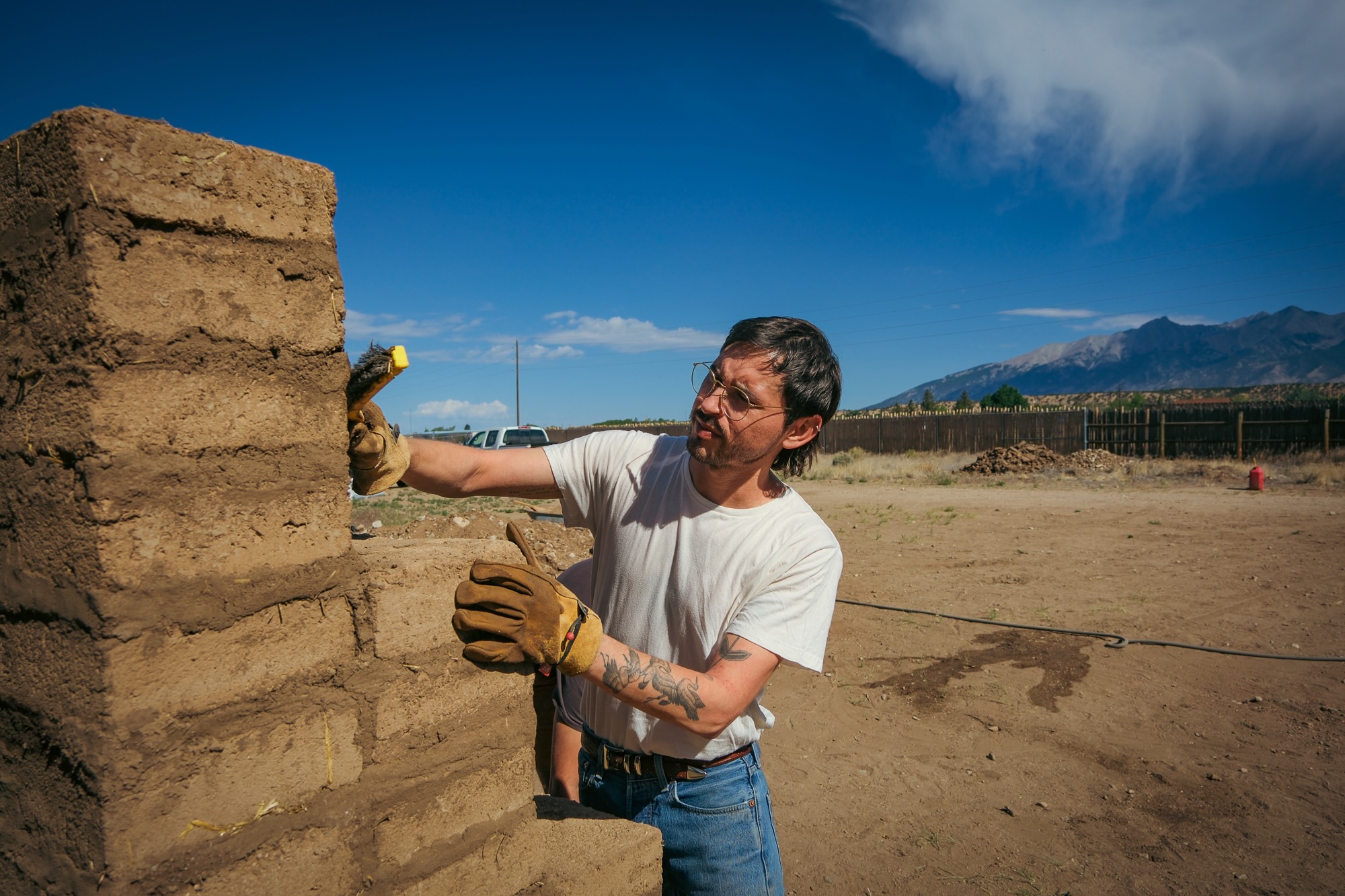
Story first appeared in:
FORT GARLAND — Throughout the history of the San Luis Valley, things have moved quickly.
Floods have shifted whole towns. Brutal winters turned populations into seasonal nomads. Cultures blended and clashed constantly. The winds, the clouds, the borders were in constant and violent flux.
To remain steady in a place with so many currents is hard work, slow work and subtle work. It is the work of building adobe structures, brick by brick, and then caring for them across generations.
“This is a pretty big year for us,” said Eric Carpio, director of Fort Garland Cultural and Historic Center on the eastern edge of the valley, where five of the fort’s original adobe buildings built in 1858 still stand.
“Colorado is celebrating its 150th anniversary as a state, while the nation celebrates its 250th. At Fort Garland, we started thinking about how to properly acknowledge this dual anniversary, but also remind visitors that the history here extends far beyond 1876, and even 1776,” he said. “Adobe is a beautiful metaphor for that.”
“We started thinking about how to properly acknowledge this dual anniversary, but also remind visitors that the history here extends far beyond 1876, and even 1776. Adobe is a beautiful metaphor for that.”
— Eric Carpio, director of Fort Garland Cultural and Historic Center
Eric Carpio stands inside an exhibit under construction holding an adobe brick to be displayed at Fort Garland Museum on June 8. (Ryan Michelle Scavo, Special to The Colorado Sun)
Adobe is the center of a joint exhibition, “Unearthing Futures/Desenterrando Futuras,” at the Fort Garland Cultural Center and the Harwood Museum in Taos, New Mexico.
The exhibition spans the region, with new installations at both museums by contemporary adobe artists, accompanied by an app that maps road trips to significant adobe sites around southern Colorado and northern New Mexico.
Works by rafa esparza, Christine Howard Sandoval, Ronald Rael, Santino Gonzales, Joanna Keane Lopez and Gabriel Chaile are on display at the Harwood, and works by Lopez and Gonzales are also at Fort Garland.
Adobe, as a substance, is incredibly simple. It’s a mix of earth, water and fiber dried in the sun to form a building material. It can be shaped into bricks by hand or using wooden molds, then stacked and sealed together using earth-based mortar.
But as a metaphor it’s much more complex, layered with the churning cultures of the region, at times a practical material, at other times exalted for its supposed authenticity, and still others admonished for not being “American” enough. It also reveals both the symbolic and physical health of a community, since adobe must be maintained, worked by many hands over many years to keep it from crumbling.
Adobe is a compression of the conditions and chance that shaped Colorado and New Mexico over millennia. It’s also a practical, abundant and environmentally friendly building material.
The past
To begin from the beginning, we have to imagine the San Luis Valley roughly 75 million years ago, as the ancestral Rockies rose and then folded, rose again and were covered in lava and ash, rose a third time to settle as the Sangre de Cristo and San Juan mountains that flank the valley we know today.
The pressing and tilting of tectonic plates formed stream beds that dry in the summer, terraces above rivers and alluvial fans at the mouths of canyons, each with a unique blend of sand, silt, clay and gravel: the adobe of Colorado and New Mexico.
All this movement really starts to matter around the year 900, when Ancestral Puebloans start digging into the earth to build the first pit houses. For the next 600 years, Pueblo architecture will shift from below-ground pits covered with arching branches, to carved out cliffsides with earthen walls, to above ground homes made by stacking wet mud.
When Spanish colonizers arrived in 1598, already familiar with earth-based buildings, they adopted the Native style, and introduced a wooden frame to shape standard adobe bricks. They built plazas and towers, and propped up dozens of fortress-like churches in an attempt to impress the Puebloans and to establish their intention to stay.
Fast forward a couple hundred years, to Mexican independence in 1821 and the opening of the Santa Fe Trail that same year; then to the Mexican-American War in 1846, and the Treaty of Guadalupe-Hidalgo in 1848; then to Colorado’s statehood in 1876 and New Mexico’s in 1912. In fewer than 100 years, the region was fought through five times over, and it shows.
LEFT: Blue skies above the adobe SPMDTU Lodge Hall on June 8 in Chama. RIGHT: Capilla de viejo under sunshine and blue skies on Nov 24, 2021 in San Acacio. (Ryan Michelle Scavo, Special to The Colorado Sun)
The adobe architecture that characterized the region until the early 1800s shifted to reflect Eastern trends, like wood trims and columned terraces that can be seen all over Santa Fe today. A brief attempt was made to “Americanize” the buildings by covering adobe with lime, sand or cement, and then reversed, once it was understood that visitors coming by newly laid railroads wanted to see the authentic New Mexican styles. The result: a mashup of cement, stucco and wood made to look like adobe that now dots the region.
Throughout the stylistic tumult, adobe remained the primary building material. In 1850, 97% of the homes in New Mexico were built of adobe, according to the U.S. Bureau of Census.
Around this time the U.S. Army was busy securing a post in the San Luis Valley to protect settlers from Native American raids. In 1856, the Army secured a lease on a small plot of land at the base of Mount Blanca for $1 per year. Fort Garland officially opened in 1858, a fortress of single-story adobe buildings with three-foot thick walls that insulated the soldiers from the Valley’s harsh winters.
In May of 1866, a man named Christopher “Kit” Carson arrived to negotiate with the Native tribes, primarily the Ute people, in the area. Carson, a Rocky Mountain fur trapper, guide and scout for the Army, has been a protagonist in the westward expansion story for decades. His name is all over the West, on towns, military installations and mountain tops. From his post at Fort Garland, Carson was instrumental in the Ute Treaty of 1868 — sometimes called the Kit Carson Treaty of 1868 — which pushed all six bands of Ute people into reservations in the Four Corners region.
Soldiers from Fort Garland marched the Utes west, depopulating huge areas of the Valley and rendering the fort all but useless. Lacking an obvious purpose, Fort Garland was decommissioned in 1882 and the remaining troops were sent to Fort Lewis in Durango.
For almost 50 years, Fort Garland was passed around among private owners until 1928, when a group of locals formed the Fort Garland Historical Fair Association and raised money selling $5 shares to farmers and ranchers hoping to turn it into a fairground. The group purchased the plot in 1929, right as the Great Depression sunk their efforts to make anything of the property.
In 1945, the Colorado Historical Society (now History Colorado) acquired the land, and in 1950 opened it as a museum, converting the commandant’s quarters into a permanent Kit Carson showcase.
Carson stayed the centerpiece of the Fort’s display for over 70 years, until 2021, when museum director Eric Carpio decided it was time for a change.
The present
For the amount of violence that Carpio thinks about on a regular basis — war, genocide, Indigenous slavery — his demeanor is remarkably gentle.
He was named the director of Fort Garland in 2019 after quietly pushing History Colorado’s community museums to broaden their perspectives through initiatives like the Borderlands of Southern Colorado.
At Fort Garland, Carpio stripped the commandant’s quarters long dedicated to Carson and mounted a show about the system of Indigenous slavery in the valley, opening the space to Chip Thomas, an artist and longtime physician on the Navajo nation.
Thomas filled the rooms with gauzy white sheets printed with an 1865 survey of enslaved Natives in Costilla and Conejos counties, and pasted historic photos of Indigenous captives to the walls. One of those captives is Juan Carson, the adopted son of Kit Carson, who was allegedly purchased in exchange for a horse
Carpio refrained from writing blocks of wall text framing that time, and instead handed the reins over to the artists and descendants involved in the project
Read more What’s Working: In Fraser, the arts — and a sprawling new arts center — become the town’s identity
“I think artists allow us to address difficult or complicated or traumatic histories with maybe a little more care and nuance than what might be offered if we just took a traditional approach,” Carpio said. “I could sit down and write an entire narrative and put it on the wall. But artists can address these really complicated topics in ways that are accessible, and meaningful, and just as effective.”
“I could sit down and write an entire narrative and put it on the wall. But artists can address these really complicated topics in ways that are accessible, and meaningful, and just as effective.”
— Eric Carpio, director of Fort Garland Cultural and Historic Center
(Ryan Michelle Scavo, Special to The Colorado Sun)
For a 2023 exhibition, “buffalo soldiers: reVision,” Carpio called on eight artists to contribute a wide range of works that examined the all-Black Army regiments established after the Civil War. The exhibition didn’t shirk the complicated legacy of the 9th regiment, once stationed at Fort Garland. It faced the contradictions of the men, recently enslaved themselves, tasked with the capture and displacement of Natives in the West. But it wasn’t just about the troubling side of the story, it was also a chance for descendants of both groups to meet, reconcile and imagine a better way forward.
“Unearthing Futures/Desterrando Futuros” is next up in this lineage of complex, artist-driven exhibitions, and decidedly the most contemporary.
Part of that is inherent to the material. Adobe is a modern building material — a downright futuristic material, depending on whom you ask — that just happens to have a history about as deep as human civilization. This is not a preservation project.
Santino Gonzales, one of the artists commissioned to create new work at Fort Garland, learned how to build adobe bricks from his father, who learned it from his father, who built their adobe home in Los Lunas, New Mexico.
His works for the exhibit include two “sound mirrors,” large concave plates modeled after a technology once used to listen for enemy aircraft before the invention of radar. Typically built of concrete, Gonzales’ sound mirrors are made of adobe. Instead of listening for warships, they refract the sounds of the landscape.
“It’s something that exists beyond me, is bigger than me, and will outlive me,” Gonzales said of working with adobe. “To be a speck in that feels special, it feels important. Not just to say ‘I was here,’ but to be a part of something that our parents and our grandparents and those before them were a part of.”
“It’s something that exists beyond me, is bigger than me, and will outlive me.”
— Santino Gonzales, on working with adobe
Santino Gonzales uses brushes and mud to finish “The Disc at Fort Garland (for Nana).” (Ryan Michelle Scavo, Special to The Colorado Sun)
In 1989, the New Mexico Bureau of Mines & Mineral Resources . They found 29 adobe brick makers, down from 48 the decade prior. Today, there are two commercial manufacturers in New Mexico, and two in Colorado.
One of those brick sites, New Mexico Earth Adobes, is one of the only remaining sites where the bricks are still made the old-fashioned way, by pouring the mud mixture into wooden molds and leaving them to dry in the sun. Near summer solstice, the process takes about two weeks, and grows longer as the days become shorter.
The bricks from New Mexico Earth Adobes form the wall built by artist Joanna Keane Lopez at Fort Garland, onto which her documentary, “A Raven Croaked Like a Witch from a Dead Pine,” will be projected for the exhibition.
The film blends footage from White Sands Missile Range, the military test site in southern New Mexico, and the Tularosa Basin, contested land that ranchers were forced out of in 1945 to make way for what was then called the Alamogordo Bombing Range. The site would become famous for the Trinity Test and, decades later, for having exposed downwind communities to its radioactive fallout. With support from the New Mexico Documentary Incubator Grant, Lopez examined her family’s history in the shadow of the military installation.
While Lopez’s work casts scenes from “the birthplace of America’s missile and space activity” onto an adobe brick wall, across the fort’s courtyard, Gonzales’ sound mirror tilts toward the sky.
The mirror at Fort Garland is for his maternal grandmother, he said, while the one at the Harwood is for his dad’s mother.
“She’s no longer with us, so it’s kind of a way of connecting with those who aren’t here anymore,” Gonzales said. “Listening for those that have come before us.”
The future
Adobe is a hopeful material. It cannot be worked alone. Gonzales brought his brothers to help him build the sound mirror; Lopez and her partner worked together on the other side of the fort.
Once built, it takes many people to maintain. When properly tended to, adobe buildings will stand for hundreds of years, through wars, floods, droughts and border changes. To build something from adobe is to also place confidence in those who inherit it.
In some places, enjarradoras are in charge of this continued care. These women fill the cracks and replaster what’s broken. At San Francisco de Asís Mission church in Taos, Guadalupe Tafoya, archivist and descendant of generations of enjarradoras, leads the community in an annual gathering to replaster the earthen walls.
For the exhibition, Tafoya curated a gallery of devotional art and adobe architecture at the Harwood Museum, centered on the San Francisco de Asís church.
“The way that she talked about her experience growing up as a Nuevamexicana, somebody with a background of many compressed, complicated, mixed backgrounds, I’d never heard somebody speak so plainly and clearly and eloquently about that kind of experience,” Gonzales said, describing meeting Tafoya during an early site visit arranged by the museums. “It’s that kind of experience that gets embedded in adobe brick. You’re compressing many cultures, and ideas, and people, into something that can build anything.”
The work is slow and labor intensive, something that artists like Gonzales relish. It’s long days in the sun, stacking, scraping, talking and connecting, to the earth and each other.
But also: The work is slow and labor intensive. Meaning, it’s not practical for the urgency of housing shortages and environmental crises of our times.
That’s part of why Ronald Rael uses robots.
“I don’t romanticize labor too much, because I do it a lot, and I know it sucks, so I like the idea that robot machines can do this and people’s labor can go to something else,” he said. Rael, an architect, thinks that eventually communities will be able to design their own houses that robots will then manufacture. “That’s sort of my goal.”
His 3D-printed adobe structures have been installed and exhibited all over Colorado, including the “Skylos” at the Frontier Drive-Inn in Center, one of the exhibition’s road trip sites. A new, 3D-printed adobe entryway will greet visitors at the Harwood.
“In some ways I’m responding to the dearth of community in making buildings, which is causing them to disappear, and so I’m trying to reintroduce them in a different way,” Rael said.
“It’s not the same as 50 people coming together,” he added. But the community aspect isn’t entirely absent. Rael still hosts workshops where he teaches people how to shape adobe bricks and make earthen plaster, connecting it to the traditions of the region. “Even the robotic buildings of the future that are made of mud will have to be maintained by someone,” he said. “Those traditional practices still have to be learned.”
Carpio, too, is looking for ways to orient the history museum he runs toward the future.
Recently, Fort Garland was accepted into the International Coalition of Sites of Conscience, Carpio said proudly. The coalition, formed in 1999, is made up of historic sites, museums and memorials around the world that are working to honestly confront the past, while enabling visitors to connect those pasts to contemporary issues. It’s a way of introducing hard histories with a soft touch.
Gonzales has a second installation at Fort Garland next to the sound mirror, a string instrument played by the wind called an aeolian harp. To build the harp he strung fishing line to the outside of the commandant’s quarters. The strings are tuned to a D chord.
Under the right conditions the harp will start to sing. But the winds in the valley shift quickly and the strings can be fickle. It’s not as simple as strong winds creating a louder noise. Some days, visitors might not hear anything at all, Gonzales said.
“Sometimes,” he said, “the gentler the wind, the more sustained the notes are.”