 By admin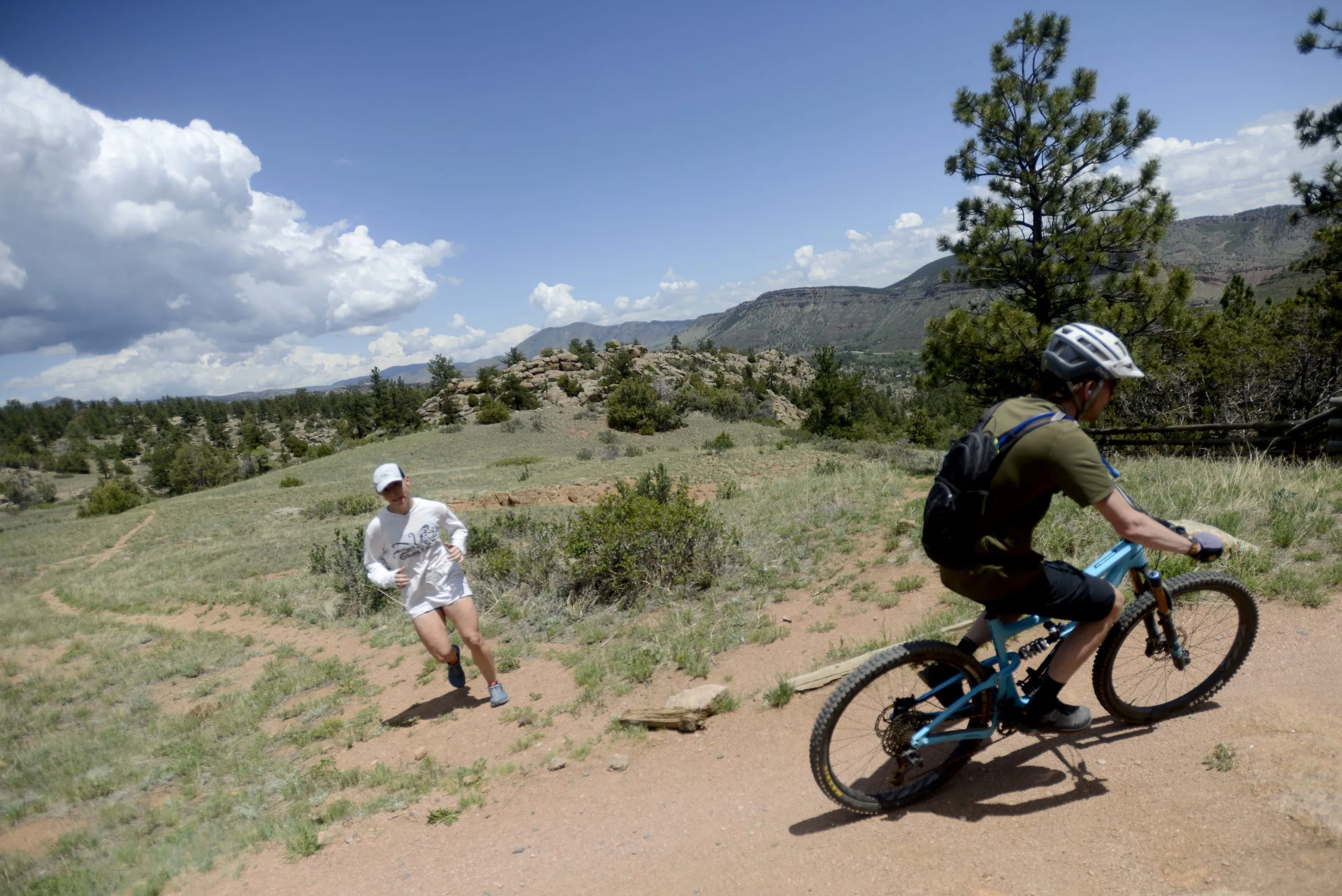
LYONS — Dave Chase started his bike shop in his garage in 2003 with a credit card.
Read more Is it illegal to sell turtles under 4 inches long in Colorado?
“It was just a way to make a little extra scratch,” he says, alone on a quiet weekday at his Redstone Cyclery shop on Main Street.
Today, selling bikes and helping pedalers is his livelihood, with Redstone Cyclery a foundation of his town’s growing mountain bike scene. And, as Boulder County considers a proposal to limit bike access on multiuse trails at nearby Hall Ranch and Heil Valley Ranch, Chase says he might have to find a new gig. But not without a fight.
First, he says, don’t call the proposal “alternating use.”
“Alternating use implies that all users alternate days. This is an alternating-day bike ban,” Chase says. “That’s all it is.”
If mountain biking is prohibited, as suggested in a recent county survey, at Heil Valley Ranch and Hall Ranch parks, “it would kill not just my business, but the town’s economy,” says Chase, who especially frets a weekend closure to mountain bikes. “Almost every single business in town, whether they realize it or not, is largely dependent on the mountain bike community. Lyons is not Boulder and I’m not sure the Boulder commissioners are recognizing that. If they close these trails, I’m going to have to look for a new place to live.”
Boulder County commissioners have asked the county’s open space and parks staff to study a pilot program that would limit mountain bike access on certain days at certain parks. Although the initial proposal focused on Heil Valley Ranch, a survey conducted by the county last month included questions about also limiting bikes access to trails at Hall Ranch as well as Walker Ranch and Betasso Preserve, where biking is already not allowed on Wednesdays and Saturdays.
A March 23 memo from county staff to Boulder County commissioners said the alternative use proposal addresses “potential visitor conflicts.”
Knobby-tired bike riders have rallied, filling recent open houses hosted by Boulder County parks staff. The proposal has particularly agitated Lyons residents, where the town has spent years cultivating a mountain-bike friendly vibe. A survey of residents about the plan has yielded more than four times the typical response, with 70% of respondents opposed to the proposal.
A letter signed by 38 Lyons residents and sent to Boulder County commissioners last week said the new restrictions “to the use of our precious outdoor spaces is of great concern.”
“As we all continue to wrestle with the existential threats of climate change and growing development, possibly the greatest tool we have to educate, inform, and make positive change is to expose as many people to the outdoors as possible,” reads the letter. “We should be looking for every responsible opportunity we can to get people outside.”
The letter writers — including 17 business owners — said the prohibition targets a specific set of users, pointing to the absence of any restrictions on hikers anywhere in the county and existing hiker-only trails but no bike-only trails. They said squeezing out mountain bikers will force them into new areas.
These riders will continue to ride, likely continue to build new trails, legally or otherwise, and simply move the issues being discussed into a neighboring jurisdiction, or into spaces that are much more difficult to police and control, “just as hikers or horseback riders would do if their use was being restricted,” reads the letter.
The alternate use proposal is not “an abstract policy” issue for Lyons, the letter writers said.
Opposition to prohibition of bikes is as high as 70%
Visits to Boulder County Parks and Open Space , with Hall Ranch and Heil Valley Ranch each accounting for more than 66,000 of those visits. The county tracked visitors who reported conflicts – hikers, bikers and horse riders who ran into some kind of issue with other people on the trails. The county counted a 4% conflict rate at Heil Valley Ranch, which is the same average for visitors to all the county’s green spaces.
The county’s top park for cycling is Betasso Preserve, where roughly 70% of the 71,242 annual visitors are pedaling. Since 2001, the county has prohibited mountain biking at Betasso Preserve on Wednesdays and Saturday, and a 2013 survey of preserve visitors showed 68% supporting the alternative use plan and 19% opposed.
Heil Valley Ranch and Hall Ranch also see a majority of visitors on bikes, while across all the county’s parks and open space, 63% of visitors were hiking and 19% were pedaling in 2025.
Boulder County Parks and Open Space collected 2,594 responses from visitors at 15 parks for its most recent five-year survey, which has not yet been published. The five-year study revealed that 4% of users experienced a recent conflict with another visitor, usually between hikers and bikers. The county manages around 116 miles of multiuse trails.
County planners recently hosted open houses and conducted a monthlong online survey to gather input on what an alternative-use pilot program might look like. The online survey, with 55% of the 7,522 respondents saying they primarily bike in Boulder County parks and open space, showed 4,500 respondents who oppose the alternating use proposal. That opposition includes a majority of hikers, runners and dog walkers.
The county usually receives around 500 to 2,000 responses to its surveys.
“The community is incredibly passionate about open space and recreation, and we appreciate their contributions to the conversation,” said Summer Alameel, a spokeswoman with Boulder County Parks and Open Space, in an email. “This type of community feedback is important to understand shifts in community values and desires.”
When asked to rank which parks should be selected for the pilot, 67% of respondents said there should not be an alternating-use pilot and 4% said Hall Ranch. When asked to detail the proposal with possible days for limits on bikes or hiking, 63% — or 4,320 respondents — said there should be no pilot program. When asked to rank their preferred alternating use schedule, 70% there should be no alternating use schedule.
The overarching theme of the April 20 to May 19 survey was opposition to the plan.
“Most mountain bikers, most of us see this as a foregone conclusion,” Chase says. “I mean they say this is about user conflict, but 4% conflict, that’s just not very much, you know?”
In the March memo from staff to the commissioners detailing a possible alternating-day access plan, staff noted “standards for acceptable level of conflict are variable” depending on activities, visitor perceptions, trail conditions and management regulations.
The staff pointed to research into recreational conflicts by Colorado State University professor Jerry Vaske, who studied issues between hikers and mountain bikers in Jefferson County in the 1990s. He said interpersonal conflicts could be avoided with increased enforcement of rules, expanded education and improved signage instead of closing trails to certain user groups.
Read more Watch: Democratic candidate forum for Colorado Attorney General
The open space staff memo noted research by Vaske that said increased management of users is warranted when conflicts reach 25%.
Vaske has worked with Jefferson County to develop alternating use strategies on some of the county’s 265 miles of trails.
The Boulder County proposal differs from Jefferson County, where, for example, there are bike-only days and hike-only days on trails at parks like Apex and Centennial Cone.
“The goal is to put a smile on your face”
There are a lot of trails in Boulder County that do not allow mountain bikers.
“If you are a hiker or an equestrian and you are looking for a bicycle-free experience, there are tons of trails all over the place,” Chase says. “Both Heil and Hall each have hiking-only trails and guess what, the Lichen Loop Trail at Heil, you need a freaking weed-whacker to get in there because no one uses it.”
Chase says the closure is going to create pirate trails as mountain bikers are pushed away from managed trails.
Giant Bikes, the world’s largest bike-maker, in May announced it was moving its U.S. headquarters to Boulder from Southern California. The People for Bikes advocacy group is based in Boulder. So is the trail-boosting International Mountain Bicycling Association.
Other communities that have embraced mountain biking are reaping rewards.
In the Grand Valley, where the Bureau of Land Management has welcomed trail development on the Palisade Plunge, Kokopelli Trail, Lunch Loops and 18 Road regions of Mesa County, mountain bikers stir an economic impact of more than $14.5 million a year and employ 345 workers who earn more than $9 million a year. That’s according to a of the role and benefits of singletrack in the region.
A found that rural communities were fueling local economies by developing trails and hosting pedalers, with out-of-area riders spending $416 every time they visit a community’s trails.
A of the then-estimated 150,000 knobby-tired pedalers who ride in the Grand Mesa, Uncompahgre and Gunnison national forests every year showed mountain bikers contributing $7.2 million to the Crested Butte economy and supporting 27 workers who earned $647,665.
Nationally, bicycling contributes $5.38 billion to the $1.26 trillion outdoor recreation economy.
And no economic pondering of mountain biking is complete without a peek at Bentonville, Arkansas, where there were less than 10 miles of singletrack 20 years ago. Today, thanks to large investment by eager pedalers in the Walton family, there are more than 160 miles of singletrack spider-webbed across northwestern Arkansas. The annual economic impact from the tens of thousands of visiting mountain bikers as well as the local riders is $159.4 million, not including $59 million in avoided healthcare costs by the region’s growing number of cyclists. That’s according to a 2023 that examined the growth of what is now called the mountain biking capital of the world.
Chase is frustrated that Lyons could appear to be dissing mountain bikers while other communities, like Fruita, Grand Junction, Gunnison and Idaho Springs, are seeing benefits from a wholehearted embrace of trail riders.
“They realize the economic importance of outdoor recreation,” he says. “Boulder doesn’t want recreation money. They just want to protect the land but in doing so, they are scaring away the people who could potentially support protecting the land. That’s the irony.”
If Boulder County commissioners ultimately decided to ban bikes on some days around Lyons, “that’s saying you are not welcome on our public lands,” Chase says. The alternating-use plan and survey results will be reviewed by commissioners at a June 30 meeting.
The Boulder Mountain Bike Alliance this month proposed directional climbing and downhill routes at Hall Ranch trails that are open to mountain bikes, noting that 6.7 miles of trails at the parks are open only to hikers and horseback riders.
“No alternating days. No complicated regulations. No dividing visitors into different groups depending on the day of the week. Just a trail system designed to provide a better experience,” the alliance suggested in a recent online post as it seeks to channel the uproar of cyclists into a positive shift at local parks. “Hall Ranch is popular because people love it. To us, that’s not a problem to solve. It’s an opportunity to make a great place even better.”
The next generation of public lands supporters and, really, the success of the national outdoor recreation economy, relies on that expanded celebration of any and all outdoor users, Chase says. The days of irked cliches — hikers dissing bikers, snowboarders hating on skiers, motorized users getting grief from everybody — are fading as more people take up all the toys for outdoor play.
“The goal is to put a smile on your face,” Chase says.
Eric Kean grew up in Lyons. He doesn’t really mountain bike. But he has plenty of pedaling pals. The owner of the MainStage Brewing on Main Street in Lyons has not heard of conflicts on the local trails, but he knows they are busy. It’s a lot of people recreating in different ways on limited terrain and it’s not surprising that issues may crop up, he says, like they do between drivers on roads.
“If the problem you are trying to address is conflict, condensing mountain bike use into fewer days of the week seems like you are going to compress the problem and force the problem into other areas,” Kean says. “I think every outdoor user group out here wants to work on this together and cooperatively. We need this to be transparent. We are talking about open space, not closed space.”
Kean says the survey conducted in the last month by the county “is a pretty clear case of them asking questions and getting answers they didn’t expect.”
Mountain biker Louie Beaupre walked into Redstone Cyclery on a recent weekday with a problem. His chain broke and he needed an expert’s help to get back on the trail. Chase hopped on the task.
Beaupre lives down the road in Longmont and he was among many dozens of local cyclists who packed a recent open house on the proposed changes to access to his favorite mountain bike trails. He’s sent emails to commissioners and filled out the most recent survey. Like Chase, he’s wondering if the perspective of mountain bikers will resonate with county leaders.
“This is a slippery slope in the wrong direction,” he says, riffing on how trails should welcome everyone to the outdoors. “I’ve never seen any signs saying ‘no hikers’ or ‘no birders.’”
Read more What to do in Colorado this week: The Colorado Renaissance Festival is upon us
He’s curious why a conflict rate of 4% would spur closed trails.
“I bet it’s 10 times that in the Whole Foods parking lot,” he says.