 By admin
Aircraft manufacturer Boom Supersonic announced plans Thursday to hire 500 people and open a new manufacturing plant near Centennial Airport. But the factory isn’t for its supersonic jets, which are expected to be used in commercial flights in 2030.
Read more Colorado has enough spare winter electricity to replace furnaces with heat pumps, report says
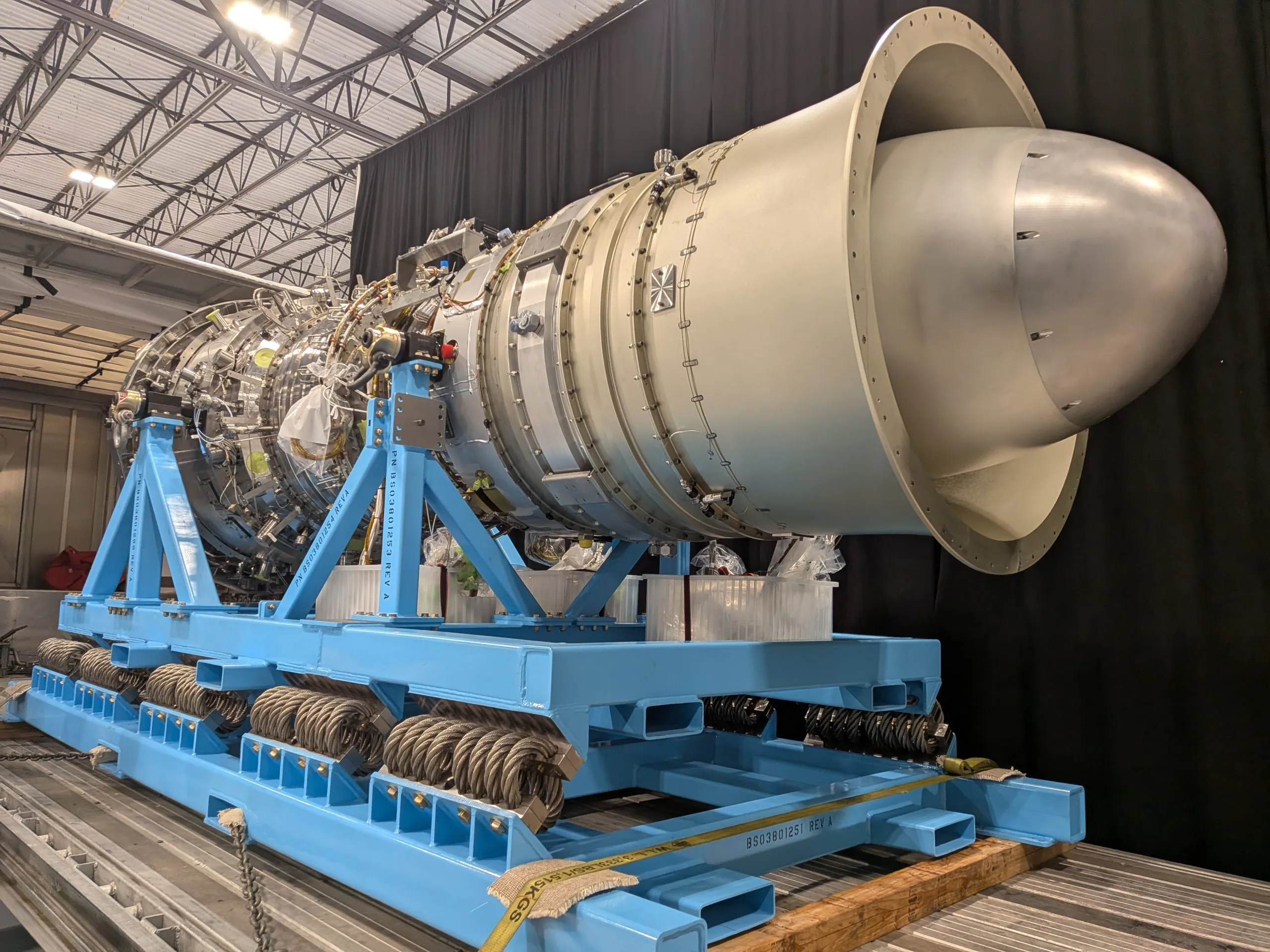
Rather, the engine is the star. The engine technology developed for supersonic aircraft has found an alternative use as a natural gas turbine engine to power data centers without relying on the electrical grid — or water. Boom calls it Superpower.
“The easiest way to overcome those problems is to enable data centers to make their own electricity and do it without a drop of water. That is absolutely what Superpower is about,” said Blake Scholl, Boom’s CEO and founder, during a news conference on Thursday at the company’s headquarters. “This is a 42-megawatt natural gas turbine that runs on that same supersonic technology, which means it’s used to being hot and it doesn’t need cooling water. Not a drop.”
The technology behind Boom’s Superpower turbines was shared publicly last year. But finding a place to build them had the company shopping around the U.S.
“We were thrilled that Colorado was able to be the most competitive. We’re thrilled to keep you here, close to home, and be part of your success story,” said Gov. Jared Polis during the news conference, adding the expansion represents a $150 million investment. “We want companies to have every opportunity to break barriers, including the sound barrier. And last year, Boom, of course, did that when its XB1 became the first independently developed supersonic jet to break the sound barrier.”
Boom, which employs about 165 people, has been headquartered near Centennial Airport since at least 2016, when it unveiled a mockup of a new aircraft to bring back supersonic travel, reminiscent of the now-retired Concorde that flew faster than the speed of sound. Boom, which has raised more than $700 million from investors, figured out how to shave regular flight times by more than half. It touted a three-hour New York-to-London flight that would take off by the 2020s, according to The Denver Post.
But supersonic flight is complicated and a Boom “superfactory” in North Carolina, where the company built its first manufacturing and testing plant, has reportedly remained idle.
Scholl said on Thursday that the company is “not exactly where we thought we would be by now.” Boom is focusing on “ground power first, airplane second,” he said. “We’re expanding turbine production first and then we’ll be able to turn our attention to the airplane and the factory in North Carolina.”
Earlier this year, Scholl had told the Wall Street Journal that regulations from a looming Colorado artificial intelligence law would add compliance costs for businesses, and could deter others from moving or expanding here. That included Boom, which was being courted by North Carolina and Texas. “We might leave,” he told the Journal. The AI law was later scaled back to require companies to only disclose AI was being used on consequential decisions instead of how it was used.
The state’s Office of Economic Development and International Trade worked with Boom to keep the company, said Polis. No financial incentives were offered by the state, an OEDIT spokesperson said.
Scholl noted that this wasn’t a headquarters announcement, but a new factory. He was excited to expand in the Denver area, “our birthplace,” he said.
“It’s great to do this under one roof, one team. But also, Colorado is home to some of the best talent in the world. We’ve got some world-leading universities,” he said.
The company has been building out the 200,000-square-foot factory all year and it produced its first parts last month. The plant has already hired its first employee and invested in numerous machines to speed up production. When it’s fully operational, which is expected by early next year, the facility can make 50 Superpower turbines a year, with the first ones slated to ship to customers by mid 2027.
“We are scaling that team of 500 as fast as we can,” Scholl said. “If 500 amazing people showed up at our front porch tomorrow, we would say welcome to all of them.”
From supersonic engine to powering a data center
The idea to turn the engine into a power source for data centers first came to Scholl earlier last year after reading about the data center power-grid crisis nationwide. Waiting lines for grid power were five to 10 years. So companies started building their own power plants but now orders for turbines have a backlog of five years, he said.
“There’s just been insatiable demand for turbines,” Scholl said. “As luck has it, Sam Altman was a day one Boom investor and I remember texting him and saying, ‘Hey Sam, this stuff I’m reading in the press about there being a power crisis, is that real? If we made a power turbine, would that be of relevance for AI?’ And he responded right away and basically said, ‘Yes, please, as many as you can make, as fast as you can make them.’”
Altman, a cofounder of artificial intelligence developer OpenAI, did not respond right away to confirm Scholl’s story.
Boom did some due diligence and felt the market was there, so turning a supersonic jet engine into a super turbine began this year. The company showed the first turbine on Thursday at its headquarters, in a ceremony attended by U.S. Secretary of Energy Chris Wright.
Scholl also said that there is “10 times more demand for this than we have production capacity. We are in the privileged position of getting to pick who our customers are,” he said. “There are customers individually that want more than 100% of our production.”
That, however, no longer includes Crusoe, an AI data center company in Denver that recently raised $3.9 billion from investors. While Crusoe was going to be a Superpower launch customer, that had changed by last month, which Scholl mentioned in a post on X. According to news site TechCrunch, Crusoe still plans to use turbines, “just not Boom’s.”
Crusoe confirmed the breakup, because it needed flexibility to choose “the energy solutions that are right for each site as its needs evolve — including turbines, along with wind, solar, batteries and the grid,” a Crusoe spokesperson said in an email. “While Boom has been a great partner, the partnership isn’t the right fit today. We wish them well.”
Read more RTD will offer free bus service along key routes to ease the ride for Sundance crowds