 By admin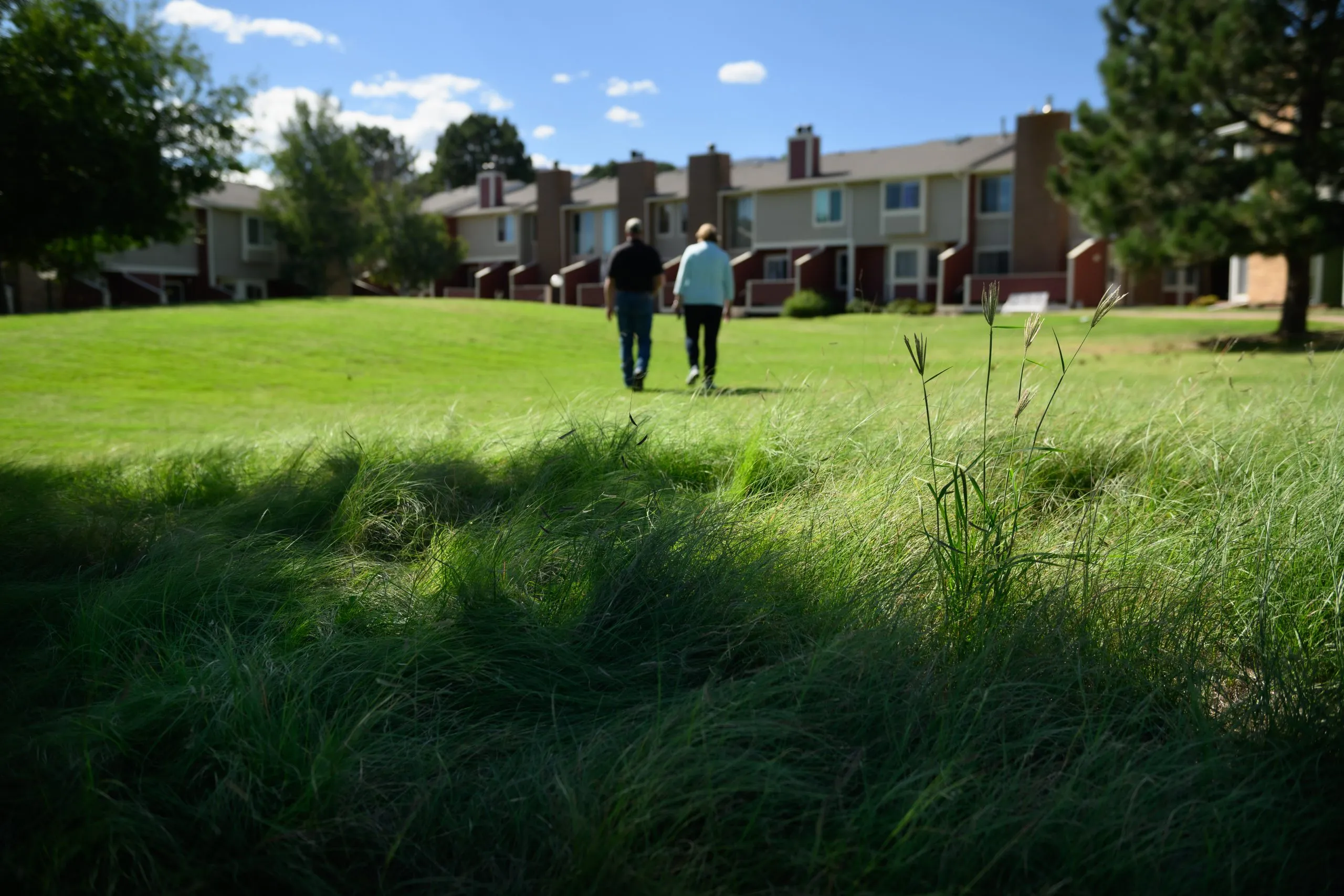
COLORADO SPRINGS — Lugging out the heavy garden hose and rolling it back up was Melissa Meadows’ most dreaded gardening chore.
So when she and her husband moved into their home just east of downtown Colorado Springs two summers ago, she researched how to transform their 250-square-foot patch of weeds and dirt in a way that required little maintenance — and a lot less water.
After doing some digging, Meadows landed on buffalo grass — a species native to the Great Plains that uses one-third of the water demanded by thirsty Kentucky bluegrass, a turf grass valued for its dense, green blades.
She enrolled in a free native grass workshop, hosted by Colorado Springs Utilities, for expert advice, seeds and high-efficiency sprinkler nozzles. Using a workbook packed with seeding and watering schedules specific to the city’s climate and guides to identify specific weeds, she and her husband began planting seeds last summer to transform their dusty patch.
This year, the grass is tall with tiny blooms poking from its green tips. Before the conversion, Meadows mowed once a week to manage the unruly weeds. Now, the yard has a meadow-like look and requires far less work.
They’ve watered the grass about three times this year and mowed it a single time.
“We’ve mowed it once because we thought maybe we wanted the manicured look, and we don’t,” Meadows said. “We found that we really don’t care about that as much as we thought we did.”
Bumblebees bounce from the tiny flowers, an unexpected source of joy in Meadows’ new lawn. And after the summer’s record-breaking heat turned the grass crisp and brown, she watched it come back to life.
“I really did think that we had killed some of it off this summer because we neglected it and we didn’t. It just went dormant, like they told us it would, and it greened back up,” Meadows said. “It’s great.”
As Colorado’s population grows and its climate gets hotter and drier, communities will have to rethink what a green landscape looks like. That may mean less traditional turf, more native grasses and a willingness to let lawns look a little different. What happened in Meadows’ yard is a small example of a much bigger shift across Colorado as pressure mounts to conserve a finite water supply.
Colorado Springs, the state’s second-largest city, has grown to roughly 500,000 people, but its total water use is about the same as it was in the 1980s. The average amount of water used per person in Colorado Springs has fallen to about 73 gallons a day, down from 139 gallons a day in the 1990s, according to the utility company.
Colorado Springs Utilities is among utility companies across the state trying to curb water use in response to a historic convergence of population growth, drought and climate change reducing snowpack and runoff, as well as pushback from rural communities wanting to protect agricultural water. There are two ways to “find” water in Colorado: Buy rights from others and put it behind a dam, or get existing customers to use less and stretch their supply to serve others.
About 7% of Colorado’s water is used for municipal purposes, a relatively small share of the state’s overall water use, compared with about 90% used for agriculture. Still, experts say water conservation in cities such as Colorado Springs is important because it allows communities to accommodate future growth without increasing water demand at the same rate.
By 2050, communities could need between 230,000 to 740,000 acre-feet more water, or up to three new Dillon Reservoirs, during the state’s driest periods if no new projects or strategies are implemented, . An acre-foot is enough water to supply the needs of two to three families for a year.
<<related: Cities in the West are booming. But will they actually need a lot more water? >>
About 35 years ago, Colorado Springs Utilities identified outdoor water use as its biggest opportunity for conservation, said Julia Gallucci, the utility’s water conservation supervisor. At the time, outdoor water use accounted for 60% or more of residential and business water use. Since then, that share has fallen to below 40%, she said.
The city created its demonstration garden to show residents that water-efficient landscaping in Colorado Springs doesn’t have to mean cacti and rocks. The garden features five landscape designs that can be watered just once a week and are adapted to the region’s heat, hail, wind and snow, including 12 types of native grasses and a variety of native and well-adapted perennials. More than 30 educational programs are offered throughout the year, including garden tours. It’s free and open to visitors during daylight hours.
“The unique ingredients for us have been education, education, education, education,” Gallucci said. “Because it’s about understanding the value of the resource we have, really stewarding it and understanding how your behavior really impacts that.”
This past summer, the community-focused garden was recognized by the American Public Gardens Association with its highest honor for public gardens, recognizing CSU for its “accessible education and outreach programs that connect people to plants.”
About 100 customers each year convert their nonnative landscapes to native ones that require far less help from humans because they are ecologically adapted to the local climate and soil. While the plants require less water and maintenance once fully established, the conversion generally takes about three years.
“It’s not just, roll it out and everything’s beautiful. This is a big challenge for people to stay the course because there’s a lot of weeds you have to fight with. There’s a lot of overseeding you need to do to really fill in the bare spots,” Gallucci said. “It takes time. It is not an immediate gratification solution.”
Since 2020, the city has also enforced permanent watering rules that allow only three days per week of outside watering. The rules supersede homeowners associations’ landscaping requirements.
The number of customers who no longer irrigate their lawns has also tripled, meaning fewer customers are actively watering or overwatering their lawns and landscapes, according to CSU.
So far, the conservation efforts appear to be paying off: From 2000 to 2025, Colorado Springs has grown by about 42%, while total raw water deliveries have dropped by 29%. Much of that was achieved by cutting per-capita water use by 44%.
The utility’s latest water efficiency plan outlines a map designed to “reduce residential and systemwide usage rates by 2.5% by 2030” that would result in 2,191 acre-feet of water savings by that year.
But some water officials say conservation alone won’t be enough to support Colorado Springs’ future growth. The Lower Arkansas Valley Water Conservancy District applauded the city’s efforts to reduce per-capita water use in response to the city’s long-term annexation plan, but urged it to before approving additional developments. The district said the city must carefully consider how it will meet future water demands and the impacts of additional water transfers on rural communities.
The debate is also playing out around the proposed “Taurus” data center near Garden of the Gods. Opponents have raised concerns about the project’s water demands as the city works to conserve, highlighting the tension between accommodating growth and protecting its water supply. The center is expected to use 200,000 gallons of water for its closed loop cooling system.
Advances in water-saving technologies and water rates have helped drive down water use across the city. But Gallucci doesn’t know how much farther those tools can take Colorado Springs.
The next gains in conservation may come less from new technology, she said, and more from changing how people use water.
Managing expectations
When Leisa Klinge learned the HOA dues for the 191-unit Townhomes of Rockrimmon that she manages could jump by 50%, from $400 to $600, she started looking for ways to cut costs.
Read more Meet the Denver chef who opened 3 Michelin star restaurants in 3 years
The northwestern Colorado Springs HOA was spending about $150,000 a year on water for indoor use and to keep its sprawling landscape green. After insurance premiums doubled to $700,000 in 2024, there wasn’t much money left to spare.
“We were cash poor, we were just paying for insurance and basic needs, so we didn’t have a lot of extra money,” Klinge said “We were just hanging on.”
Klinge and the HOA’s five-person board visited CSU’s demonstration garden to explore drought-resistant landscaping before pitching the idea to residents.
The HOA received $120,000 in conservation grants from CSU, including $40,000 to improve its aging, 1980s-era system, which was prone to costly repairs.
Then, last May, the HOA started its 100% native grass conversion across the 200,000-square-foot property, planting a 50-50 mix of buffalo grass and blue grama, another grass native to Colorado that thrives in sunny spots and requires watering once a week.
About 14 months into the project, the changes have already produced significant savings. The community cut roughly $20,000 from its landscape maintenance contract because mowing crews now come every two to three weeks, as opposed to every Thursday.
“Between water and landscape maintenance, the community saved north of $50,000 a year,” Chad Anderson, general manager for Anderson Landscaping, said, sitting in a long, billowy patch of blue grama.
Those savings are helping the community invest in other overdue improvements and avoid another increase in dues.
“They’re going to stay flat for a while, just because we’re going to save a ton in water,” Klinge said.
As landscaping crews began removing the nonnative turfgrass with chemicals, Klinge and the board held town halls every two to three weeks from May to August to walk residents through the process and address their concerns.
“Because education is going to make or break you,” Klinge said. “If you don’t communicate well and often, people are going to be mad.”
Still, reaching homeowners was hard and they were bombarded with phone calls. More than a year after seeding, it’s still about managing expectations and finding a middle ground with a diverse group of nearly 600 people — many young families with kids and pets and about a third of whom are retired — who call the neighborhood home.
Landscapers have created “beauty bands” through the tall, meadow-like native grasses by mowing pathways next to the sidewalks, so it’s not rubbing against people’s legs while walking past.
After one resident insisted his yard be kept as short as traditional Kentucky bluegrass, management developed a mowing plan that will cost a little more but allow for a mix of grass heights, including taller native grass.
“He’s agreed to let it go four weeks, so there’s going to be about a 10-day window in there where they’re not going to be super pleased with it. That’s kind of the compromise,” Anderson said.
The redesign also meant making trade-offs based on how residents use the property. Native grasses aren’t the best choice for high-traffic areas or places where children play, Anderson said. So the community planted Tahoma 31, a nonnative turfgrass that follows the same watering cycle as the native grasses but needs to be mowed only every three to four weeks. It stays soft and relatively short, reaching about 3½ to 4 inches.
For Anderson, shifting customers toward native grasses and other water-efficient landscapes could mean less revenue from traditional lawn maintenance in the short term. But he sees adapting to Colorado’s growing water constraints as both a priority and an opportunity to rethink how his company does business that is “a part of tomorrow’s landscape, not necessarily yesterday’s landscape.”
In late August, the blue grama grass in the center of the courtyard was tall and waving in the breeze. Some bald spots needed reseeding, and some areas needed weeding. But Anderson said the community is on track to thrive with less water.
“Colorado Springs will go to one-day-a-week watering and they will be in good shape. This is a community that will thrive under that environment,” Anderson said.
His advice to other communities is to start planning before they are forced to.
“Save every drop that we can”
On a recent September morning, two white golden retrievers bounded through the tall blue grama grass at Keller Park in northeastern Colorado Springs. Just a few feet away, Kentucky bluegrass was neatly trimmed almost to the ground.
The difference is more than aesthetic: The native grass is mowed just three times a year, compared with 32 times for the Kentucky bluegrass. The patch was one of the city’s first native-grass conversions, started in 2012. Since then, Colorado Springs Parks and Recreation has converted 102 acres of Kentucky bluegrass to native grasses, about 10% of the city’s total irrigated park acreage.
This season, the city saved 26 million gallons of water over the 102 acres of converted grass and $327,000 — $52,000 of that was saved on mowing, aeration, fertilizer and weed control.
“I think what a lot of it comes down to is bandwidth,” Eric Becker, Park Maintenance and Operations manager, said of trying to encourage more conversions across the city. “We’re stretched on our resources at parks big time, and where these do give us savings, it is an amount of work to manage all these sites.”
Another massive hurdle, Becker said, is changing the way landscaping crews think about grass. Native grasses require a different approach than the manicured turf they’re used to maintaining, from mowers with higher deck heights to more frequent equipment washing to keep weed seeds from spreading between sites.
“The learning curve is huge,” Becker said.
When the city began its first native grass conversion in 2012, Becker said it felt like a pioneering effort. More communities are embracing the approach now, but the transition has been gradual.
Now, Scott Hunt, a water conservation specialist with Colorado Springs Parks and Rec, is part of a statewide native grass working group with municipalities and contractors from around the state to talk about what’s working and what isn’t.
Native grass conversions are just one piece of the city’s water-conservation strategy. Parks also use flow sensors and smart irrigation controllers that alert technicians when a sprinkler is using more water than it should and can shut the system off automatically.
That effort comes against a backdrop of growing strain on the Colorado River.
“There are millions of people that rely on that river and that river is kind of overutilized, to say the very least,” Hunt said. “So everybody is just trying to kind of get on board and save every drop that we can.”