 By admin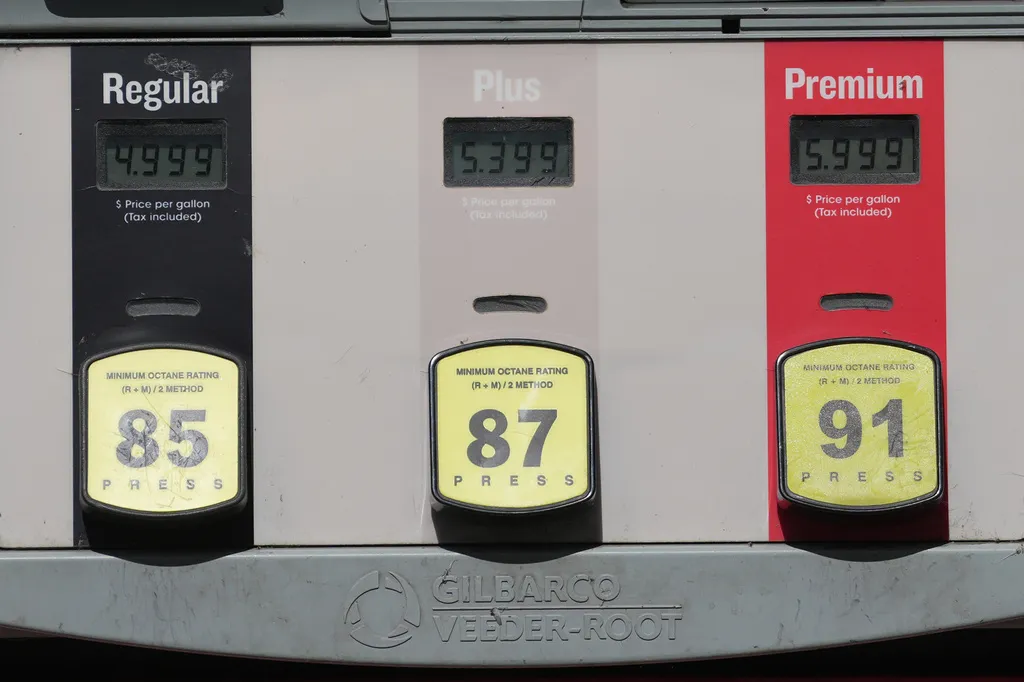
Republican U.S. Rep. Gabe Evans’ response to the Trump-created challenges battering his reelection campaign in the 8th Congressional District this year has been to redirect the conversation toward how decisions made on the state level by Democrats are affecting his constituents.
Read more Trump-tied super PAC has already spent about $1.5M defending Gabe Evans, Jeff Crank in Colorado
That’s how he’s approaching gasoline prices, which have skyrocketed since President Donald Trump launched his war in Iran, which Evans supports.
“Sure, there’s national components to this,” he said at an August event in Thornton, “but there’s very, very much a state component where you have the state of Colorado, under Democrat control, that has declared war on oil and gas for the last eight years.”
Evans pointed to how fuel prices in Colorado are higher than the national average as proof that the price increases are a state issue.
“We know there’s some impact from what’s going on overseas, but we also know there’s an incredibly local impact to costs,” said Evans, who faces Democrat Manny Rutinel, a former state representative, in one of the nation’s most competitive congressional races.
That’s not what the experts say and it’s not what the numbers show.
Yes, Colorado’s gas prices have been higher than the national average in recent weeks. On Friday, the average price of a gallon of regular gasoline in Colorado was $4.35 compared to $4.30 nationally, according to AAA.
But diesel fuel in Colorado was also about 25 cents cheaper per gallon than the national average on Friday. And more than a dozen states had higher gasoline prices.
A year ago, before the war in Iran began and the Strait of Hormuz, an oil artery, closed, AAA reported the average price of gasoline in Colorado was $3.17, about a cent lower than the national average.
Skyler McKinley, a spokesperson for AAA Colorado, said gas prices fluctuate for many reasons, the least of which are state and local regulations. Take how prices fluctuate even within the state of Colorado: The average cost of a gallon of gas was $3.98 Friday in Lincoln County on the Eastern Plains while it was $4.75 in Garfield County on the Western Slope.
Gas is not regulated differently in those two parts of Colorado, but transportation costs, competition and demand vary.
“The rise in gas prices over the past year has all been the function of policy choices,” McKinley said. “They are policy choices that affect the going rate for crude oil, which is traded globally and is weighed globally.”
McKinley also highlighted how local oil and gas production has little to do with prices at the pump.
“Eighteen states produce no oil and gas whatsoever,” he said. “The median price for those states is around $4.25. Colorado, which is the No. 4 oil and gas producer in the country, has prices around a dime higher than states with no production. So policy choices that lead to increased or decreased oil and gas production don’t play out in gas prices.”
Read more US Supreme Court rejects Trump mail ballot restrictions ahead of midterms
Grier Bailey, who leads the Colorado Wyoming Petroleum Marketers Association, a trade group that represents gas stations, said wholesale gas prices are predominantly determined by the price of crude oil.
But there are many other factors at play, too — albeit at a smaller level. Property taxes, labor costs and what products can be sold in convenience stores attached to gas stations are part of the equation. And, yes, state oil and gas regulations may play some role, Bailey said.
“Do I think the Colorado legislature, which has been run by Democrats over the past 10 years, has forced us into higher prices?” he said. “I think that it’s true that local supply would put downward pressure on that. But the factors that drive oil prices are not solely based on local regulation.”
Bailey said Evans and the Trump administration deserve credit for prices not being even higher right now in Colorado because the Environmental Protection Agency waived the requirement that reformulated gasoline be sold in the Denver area this summer to help improve air quality.
That decision, at Evans’ urging as a member of the House Committee on Energy and Commerce, was made by the EPA because of higher gas prices caused by the war in Iran. And Bailey said Colorado gas station owners are very grateful.
Republican National Committee Chairman Joe Gruters, during a visit to Colorado last month, acknowledged that the war in Iran, and its effect on global oil markets, is causing higher gas prices. But he defended Trump’s decision to start the conflict.
“The president’s main priority and task is to keep Americans safe,” Gruters said. “It’s a national security thing. We don’t always see what the president sees.”
But Evans has remained steadfast in his claim that Colorado Democrats are to blame for high gas prices in the state.
“We should be lower than the national average,” he said last week after an event at a truck depot in Commerce City. “Democrats are doing a complete hypocritical bait and switch when they talk about gas prices.”
But Evans himself has changed his explanation for gas prices over the past year depending on whether they’ve been high or low.
For instance, in February, before the war in Iran began, the congressman was lauding the Trump administration and Republicans for lowering gas prices by easing regulations on oil and gas production.
“We’ve had some of the lowest gas prices in the nation at the pump,” he told The Colorado Sun, “and that’s because when we can actually produce that here in the country rather than smothering it under regulations, energy prices go down.”
Read more Teen girl, woman injured in 2 more bear attacks in southwestern Colorado
He added: “Energy prices are always top of mind for my constituents.”