 By admin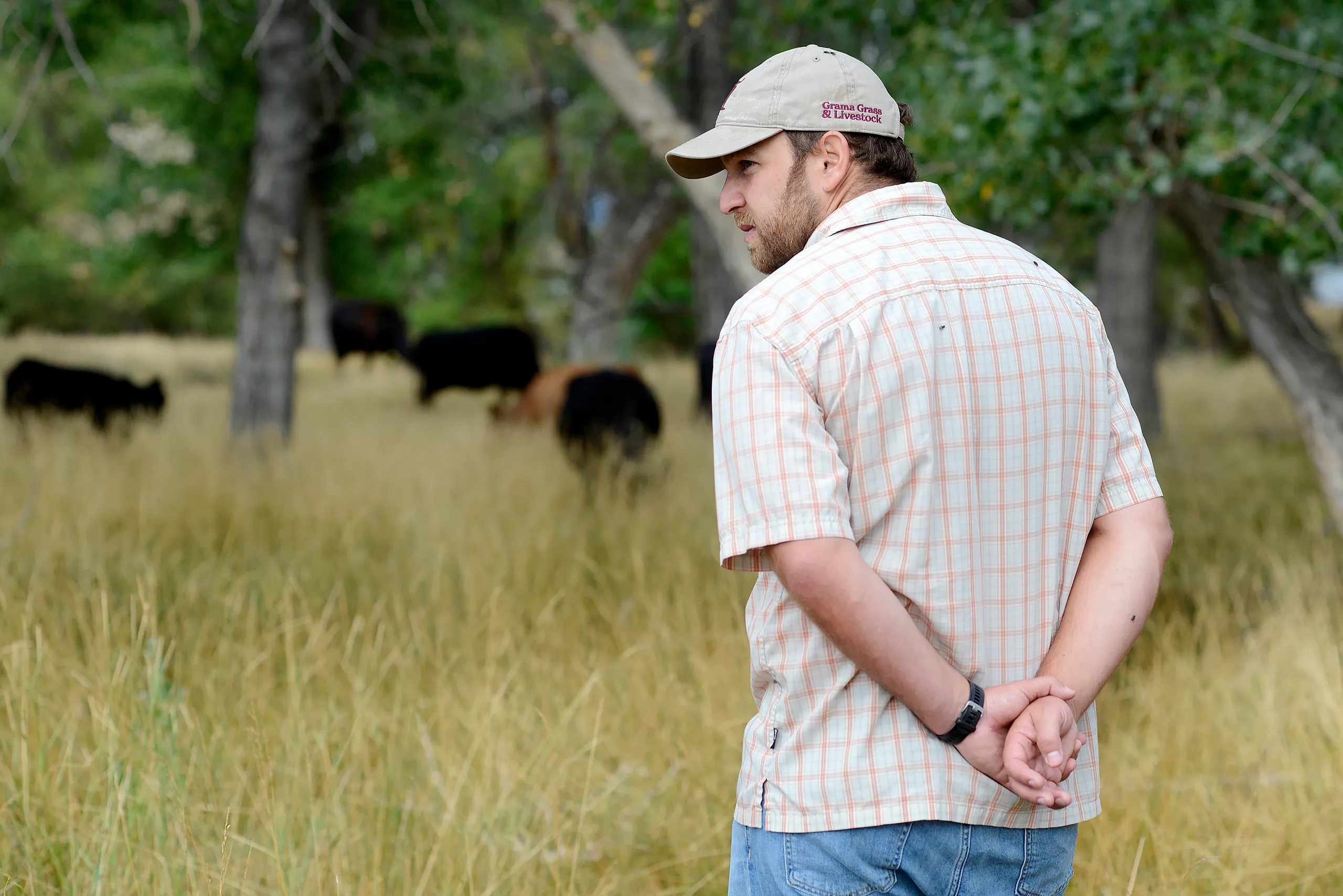
LONGMONT — On a recent morning a ways off the Diagonal Highway in Boulder County, first-generation rancher Andy Breiter stopped strolling, cocked his head to the side and said, “It’s peaceful listening to them munch their salad.”
It was breakfast time for the cows Breiter raises for Grama Grass & Livestock, the ranching and regenerative agriculture business he owns in Longmont. Between 4 and 6 years old when he bought them, most of the adult cows are in what he calls hospice: The finishing stage where they’re gorging on tasty grasses, still butcher bound but living large as they graze their way around Boulder County.
Breiter’s cattle never graze the same pasture more than once in 24 hours. Instead, he and his small crew of workers rotate them across a patchwork of public and private land through contracts he has with different owners.
It’s a convenient arrangement: The cows get a steady supply of healthy grass, and the land reaps the benefits of grazing similar to when thousands of bison roamed the region’s prairie ecosystems, trampling the soil and causing aeration, recycling nutrients and boosting plant diversity, all while keeping flammable grasses in check through their steady mowing.
Breiter and his partners — including the city of Boulder’s Open Space and Mountain Parks Department, the city of Louisville, private landowners and several farms — benefit, too. In exchange for pasture access and a sliding-scale fee to landowners based on things like the size of a parcel, quality of grass, access to water and distance from Grama Grass headquarters, his cows fertilize the land with manure and stimulate perennial plants to regrow while building deep, strong root systems that improve soil health, sequester carbon and, over time, regenerate landscapes to a more balanced and native state.
It has also led to financial success. Between 2020, when he founded Grama Grass, and today, Breiter’s operation has grown from 25 cows grazing one 70-acre pasture to an average herd size of 90 cows grazing 700 acres across 20 pastures. Along the way he grew his beef sales to 85,000 pounds in 2025 and his business into a million-dollar enterprise selling meat in dozens of locations including the Coperta restaurant in Denver, the Rang Tang Craft Barbeque food truck in Longmont, Lucky’s Market in Boulder and the Organic Sandwich Company in Louisville.
Breiter’s success stands out as a rare bright spot in a cattle industry that’s been in disarray since President Donald Trump returned to office. First, he imposed tariffs, then skyrocketing import duties and then, on Aug. 21, Trump announced on social media he would flood the U.S. cattle market with 300,000 metric tons of foreign beef, which Travis Grant, CEO of the Colorado Livestock Association, says has less fat than what’s grown in the U.S.
The meat, technically lean trimmings, will mix with American ground beef to make the 80% or 90% lean ground Americans prefer, Grant said. It’ll be sold at roughly 25% below current market prices to help lower costs at the grocery store for consumers. But Grant said the impact was an immediate drop in cattle prices and instability at a time when drought, high operating costs and the lowest cattle supply in 75 years, due to the drought, fewer ranches and the several years it takes to grow a new generation of breeding cattle, already make the operations of ranchers across Colorado fragile.
By being nimble, building partnerships that let Breiter graze in a relatively urban area for a price he can negotiate and selling his beef directly to local stores, restaurants, food banks and the University of Colorado, could he have built a Trump-proof model?
It is, and isn’t, political
Grant said Colorado cattle industry leaders are angry at Trump because they weren’t invited to weigh in before his decision to flood the market with foreign beef at a time when many producers are already so strained they’re grappling with whether to sell their cattle.
Last month, Grant spoke to the owner of a 100-year-old ranch in El Paso County who took a gamble that the market would stay steady and held off selling her steers in July. Now needing money to pay for hay, she’s being forced to sell in a deflated market.
On Sept. 4, Grant said American beef prices remained lower than they were a year ago “and are on a downward trajectory.”
“The USDA has announced a slate of ‘Ranchers First Initiatives’ designed to support rebuilding the U.S. cattle herd,” he added, “but many of those efforts, which range from encouraging heifer retention to enhancing regional processing and expanding grazing access, were already in motion.”
The El Paso County rancher’s situation “is by no means unique, and an example of the real-world impacts that come from announcements like Trump’s,” he said.
But Breiter, who votes Democrat but doesn’t call himself a Democrat, doesn’t blame Trump alone for those impacts.
Consolidation versus the independent rancher
Breiter is 36, sturdily built and soft spoken.
He grew up on the North Shore of Chicago and studied business at the University of Denver. Along the way he became interested in global food systems and regenerative agriculture, which he learned about by working on farms in Boulder, Illinois and Spain and on a ranch in Wyoming.
When he moved to Boulder County, he joined the Flatirons Farmers Coalition, which is made up of area farmers, ranchers and local food advocates working to create an inclusive regenerative agricultural community. Regenerative agriculture is an approach to farming and ranching that improves soil health, restores ecosystems and fights climate change.
He sought funding to start Grama Grass from SOIL Boulder, a chapter of the Slow Money Institute, which gives 0% interest loans to local farmers and food producers who wouldn’t be able to get into production agriculture without them. And he received funding from Mad Agriculture, which helps new farmers break into the industry and some family investment.
He calls Grama Grass’ headquarters — a 78-acre farm spread he rents with a barn, beehives and chickens — the “home place,” but he lives elsewhere (he didn’t say where).
And he says the beef from his 4- to 6-year-old cows “is a lot richer in flavor. Although it can also be tougher and more toothsome as a whole because the animal is older. That definitely challenges the American palate. But if you look at places like France or even Argentina, that’s a lot of what they eat in general.”
Breiter said the food industry has been consolidating for many years especially in the cattle sector, with four multinational corporations — JBS, Cargill, Tyson and National Beef Packing Company — owning upward of 85% of the beef market.
The consolidation of buyers limits where ranchers can sell their cattle and for how much. It also gives the government greater influence on the industry since the meatpacking market is largely made up of just a few companies.
“That’s created a lot of farmers and ranchers being what I would call ‘price-takers’ and the commodity markets and major changes to policy really impact you if you’re a price-taker,” Breiter said, meaning if you’re a rancher who sells cattle as a raw commodity to a feedlot or packing plant instead of creating your own markets, you’re at the whim of decisions like Trump’s.
The Colorado Livestock Association’s Grant said there are plenty of Colorado ranchers who create their own markets by selling direct-to-consumer, but also plenty who sell to feedlots.
And there’s proof the latter group is being impacted by the flood of beef: The El Paso County rancher just saw cattle prices drop by $200 per head since Trump’s announcement in late August.
The beef giants of the world should be just fine, though. “If it’s gonna benefit any of the processors, it will benefit the big guys, who are more likely to be importing the lean trim foreign countries have a greater supply of than the U.S.,” Grant said. “So theoretically, these producers who will likely be functioning as the importer will be catching that discount, and that will allow them to sell these products or have a bigger margin on these products.”
The Colorado Sun emailed Cargill for comment but they did not respond.
Why ranchers like Breiter might have an advantage
Breiter and his employees move the Grama Grass cows from one pasture to the next at least once and as often as three times a day.
And because the cows spend so much time with humans, they’re not bothered when one walks alongside them or stares them in the face.
They know what human presence means: When Breiter and his assistant ranch foreman Katie Johnson were ready to rotate the herd onto a part of a pasture that had been resting ungrazed for several days, they coiled the portable electric fence that had been blocking them in and the cows sprinted to the glistening new grass to gorge to a chorus of crickets.
Like other Colorado ranchers, Breiter has been hit with drought, soaring gas and equipment prices and global disruption.
But Trump’s beef flood also means if Breiter wanted to, he could pick up some new cows at the Centennial Livestock Auction in Fort Collins at a discount.
And here’s another benefit: He’s about as direct-to-consumer as one can get.
“There’s a lot of (restaurants) that cook our meat and then sell it to the consumer, but it’s much nearer to the finish line of the plate,” he said. “And that creates a lot more stability for us in price changes — we’re not reliant on the policymakers or something happening in China.”
Read more What’s Working: Colorado’s aerospace industry fears it may be losing ground